
By GM Ulvi Bajarani, Founder and Head Coach of Azeri Chess Academy
When a rook, bishop or knight is better than a queen
Reaching the last rank is not the end of the calculation. A pawn can become a queen, rook, bishop or knight, and the strongest piece is not always the right piece for the position. Sometimes a queen gives the opponent a draw, while a smaller piece keeps the win. Sometimes only a knight can make the required double attack.
Choosing a rook, bishop or knight instead of a queen is called underpromotion. The goal is not to find an unusual move for its own sake. It is to choose the piece that does the exact job the position requires.
The promotion rules
White promote on the eighth rank; Black promote on the first. Promotion is compulsory and happens as part of the pawn move, including when that move is a capture. The new piece must be the same color as the pawn. It cannot be a king or another pawn, and its powers take effect immediately.
The choice is not limited to pieces already captured. You can have a second queen, a third rook or another bishop of the same square color. In notation, f8=R means promotion to a rook; e8=N+ means promotion to a knight with check.
Official rule reference: FIDE Laws of Chess, Articles 3.7.3.3–3.7.3.5
A rook leaves an escape square
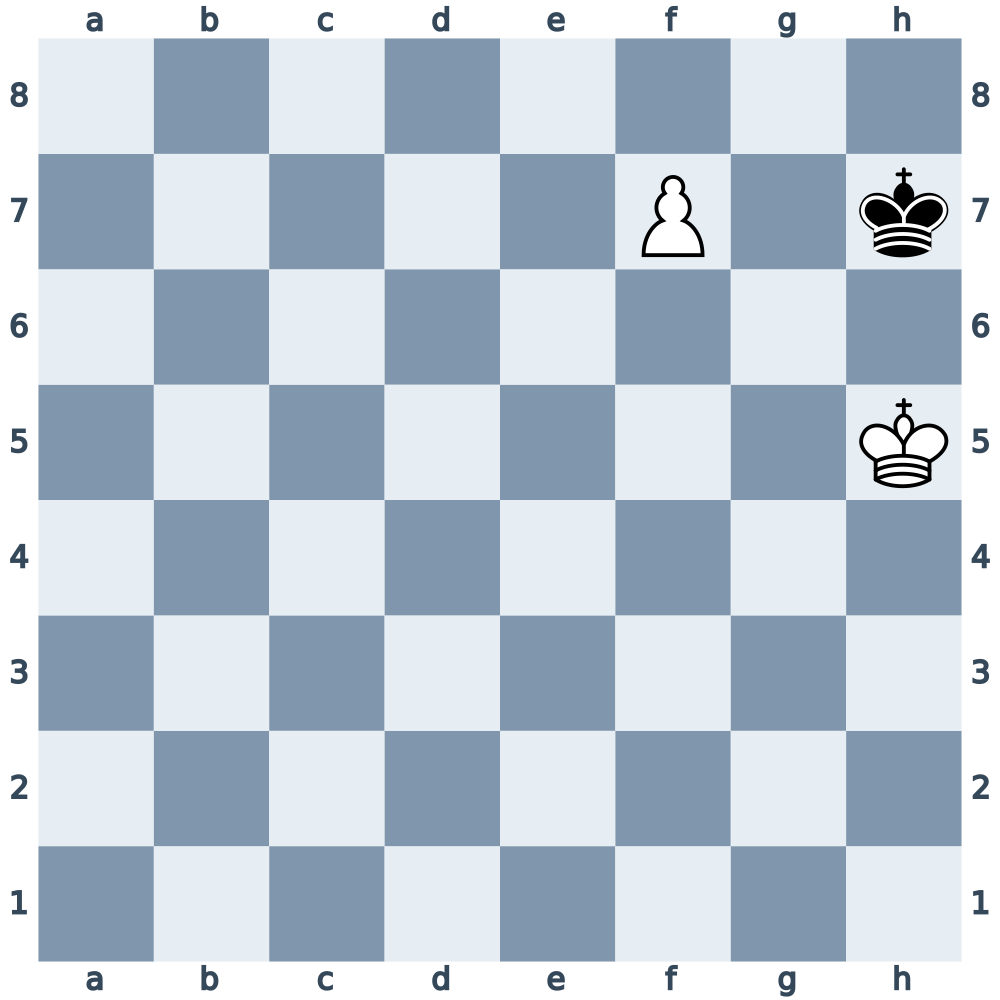
White have a king on h5 and a pawn on f7; Black have only a king on h7. The tempting 1.f8=Q is stalemate. Black are not in check, but they have no legal move: the queen controls g8, h8 and g7, while White’s king controls g6 and h6.
The solution is 1.f8=R! The rook still controls the eighth rank, but it does not attack g7 diagonally. Black can play 1…Kg7, so the game continues. White retain the familiar winning endgame of king and rook against king.
What about the other choices? After 1.f8=B or 1.f8=N+, White have only a single minor piece and their king against a lone king. Neither material combination can produce checkmate. Those promotions draw, even though the knight promotion gives check.
This is the first important distinction: a check is not automatically better than a quiet move. Here, the quiet rook promotion wins, the checking knight promotion draws, and the queen promotion ends the game immediately in stalemate.
The rook works precisely because it controls fewer squares than a queen. When the opponent has almost no mobility, an extra diagonal can be a disadvantage. Before choosing a queen, identify at least one legal reply if the move does not give check.
Continue with Basic Checkmates for Beginners
A knight creates a fork
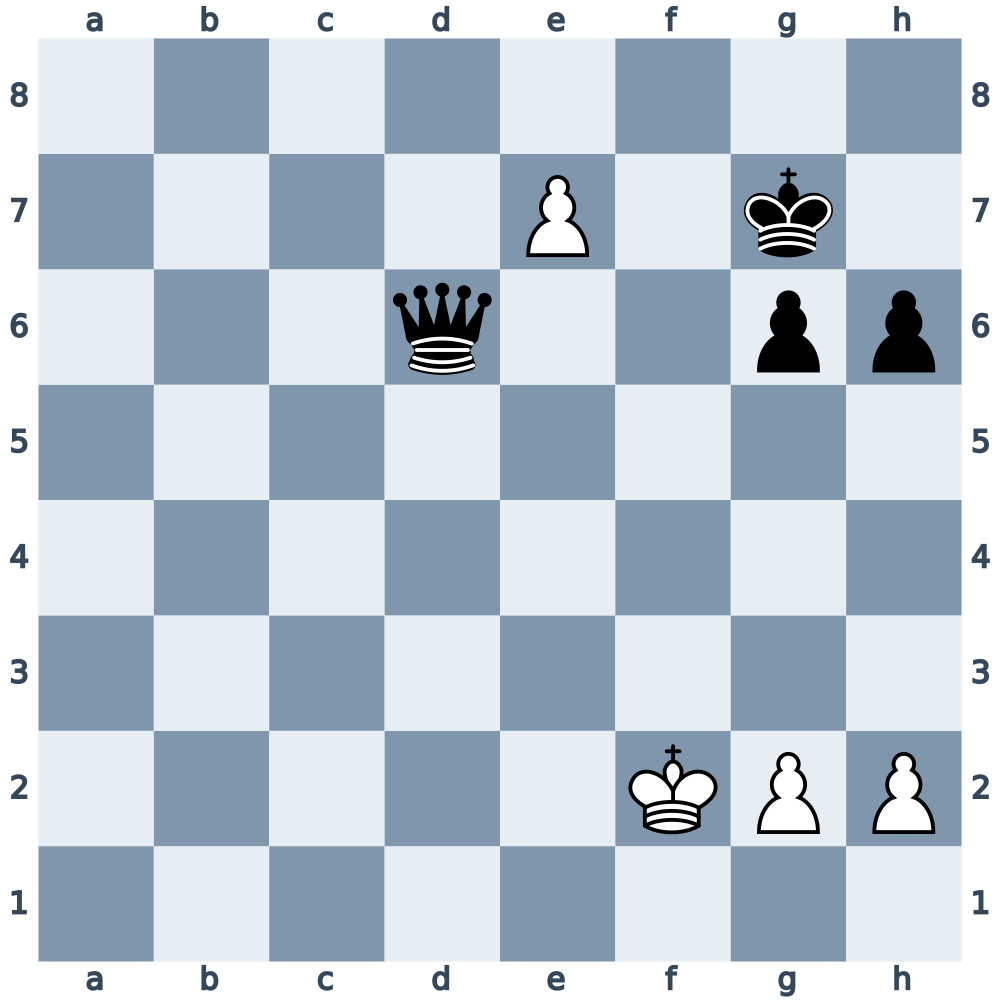
A queen combines rook and bishop movement, but it cannot move like a knight. In this position, White play 1.e8=N+! The knight on e8 attacks Black’s king on g7 and queen on d6 at the same time.
Black must answer the check. Their legal king replies are 1…Kh8, 1…Kg8, 1…Kf8, 1…Kh7 and 1…Kf7. After every one of them, 2.Nxd6 captures the queen. A knight check cannot be blocked, and Black have no piece that can capture the knight on e8.
For example, 1.e8=N+ Kh7 2.Nxd6 leaves White with a knight and two pawns against two pawns. The important point of this example is the forced queen capture, not an instruction to ignore the resulting pawn ending or the safety of the knight.
A queen promotion does not deliver this fork. After 1.e8=Q, Black are not in check and have time for their own move; 1…Qf8+ is one legal countercheck. Rook and bishop promotions also fail to create the knight’s double attack. Calculate the actual moves rather than assuming that a more valuable new piece must do everything a smaller one can do.
When a pawn is about to promote, look at the squares a knight would attack from its destination. A king and queen, king and rook, or king and an important defensive piece may form a fork. Check whether the promoted knight survives and whether the second target can really be captured afterward.
A knight avoids stalemate
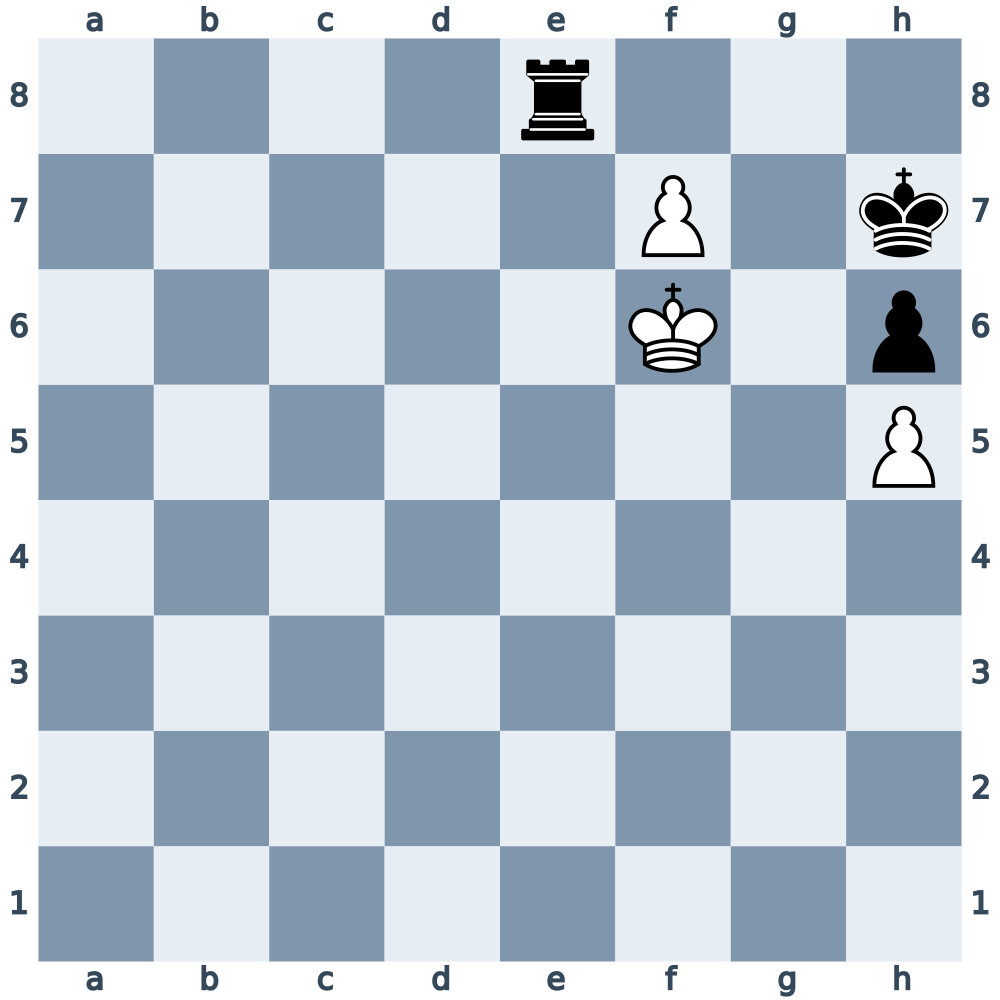
White can capture the rook with fxe8, but choosing the new piece carelessly throws away the win. Both 1.fxe8=Q and 1.fxe8=R are stalemate: the new heavy piece closes the eighth rank, White’s king covers g7 and g6, and Black’s h6-pawn cannot move because h5 is occupied.
The winning choice is 1.fxe8=N! Black can move to g8 or h8. White have a knight and an h-pawn against an h-pawn, with an active king. Unlike the queen and rook promotions, the knight keeps the position alive; unlike the bishop promotion, it preserves a theoretically winning ending.
After 1.fxe8=B, Black can also move, but the ending is drawn with correct defense. White’s bishop travels on light squares and cannot control the h8 promotion corner. This is the wrong bishop for an h-pawn. Black can stay near that corner, so merely avoiding immediate stalemate is not enough.
The knight is not tied to one square color. It can help dislodge the king and support further progress. The exact conversion still requires care: winning an endgame does not mean every move wins. Practice this position against resistance, and keep checking for stalemate as Black’s legal moves become scarce.
This example adds a second question to the calculation: after the promotion, is the resulting endgame actually winning? A legal move that avoids stalemate can still leave a theoretical draw.
The bishop has a specific job
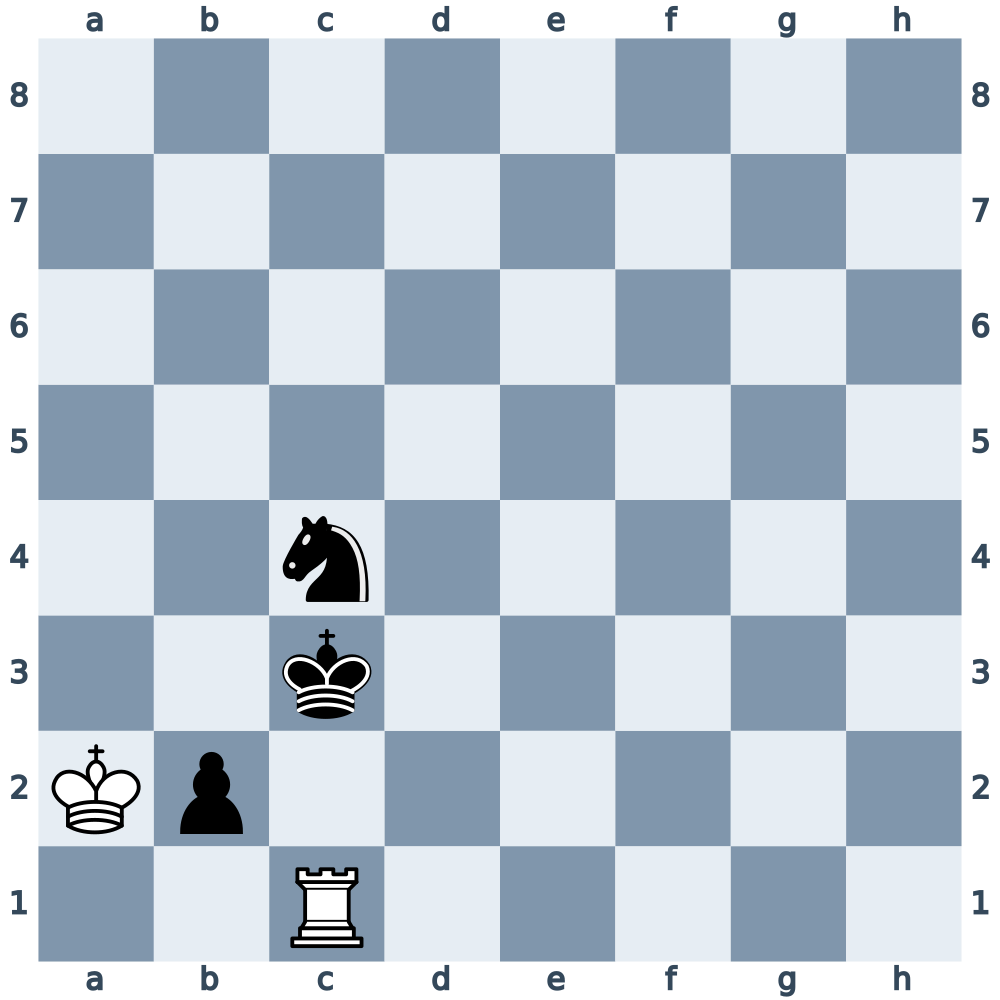
Black can capture the rook with 1…bxc1, but a queen or rook would leave White stalemated. The king on a2 is not in check. Black’s king covers b2 and b3, the knight controls a3, and a queen or rook on c1 would close a1 and b1.
The correct choice is 1…bxc1=B! White can move to a1 or b1, and Black reach a winning king, bishop and knight against king ending. This is a more advanced checkmate than king and rook, but the material is sufficient to force mate with correct play.
The alternative 1…bxc1=N+ avoids stalemate too, yet leaves two knights against a lone king in a theoretically drawn position. Two knights cannot generally force checkmate against a lone king. That is different from saying checkmate is impossible: cooperative mating positions exist, so this is not automatically a dead position merely because two knights remain.
Here, the bishop is neither a decorative choice nor a reward for finding the rarest move. It is the only promotion on c1 that both avoids stalemate and retains a winning ending. First examine king mobility; then evaluate the material you will actually have.
Practice positions and solutions
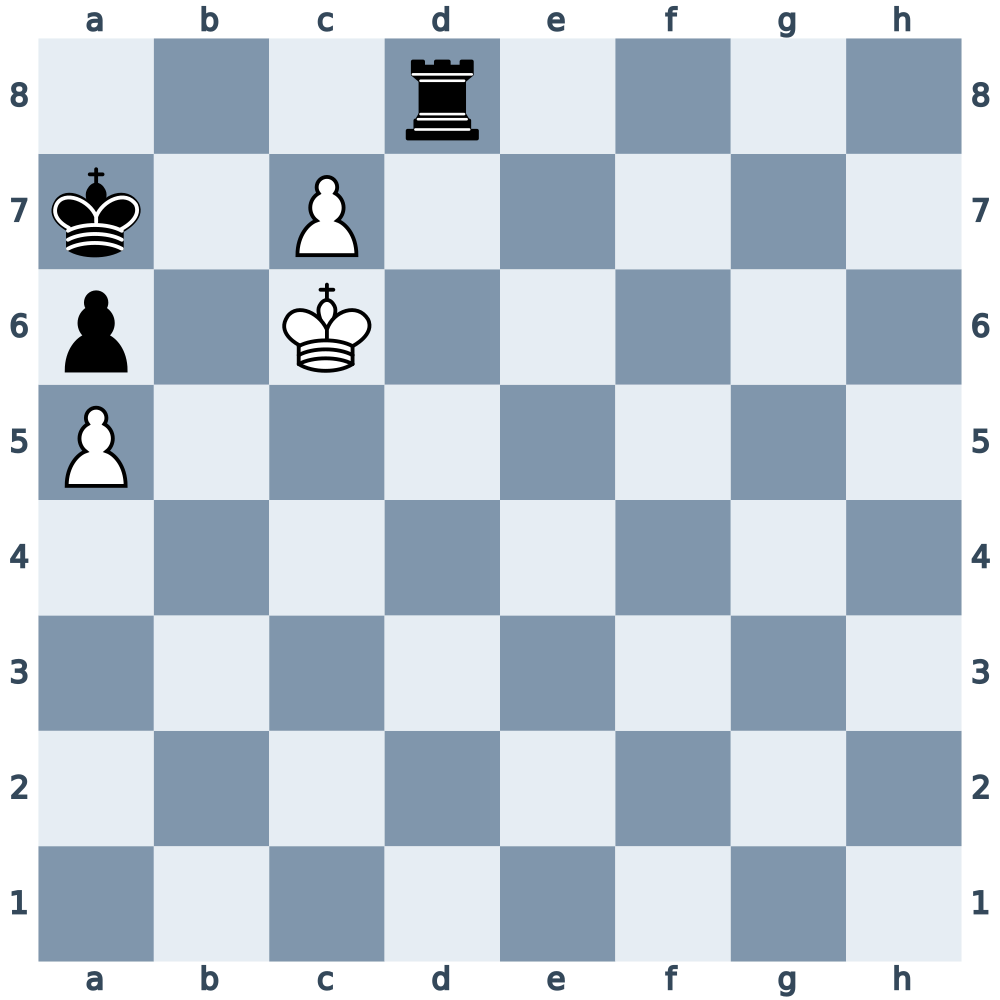
These two positions reflect earlier examples across the board. Solve them without looking back. State the move and explain what happens after each of the other three promotion choices.
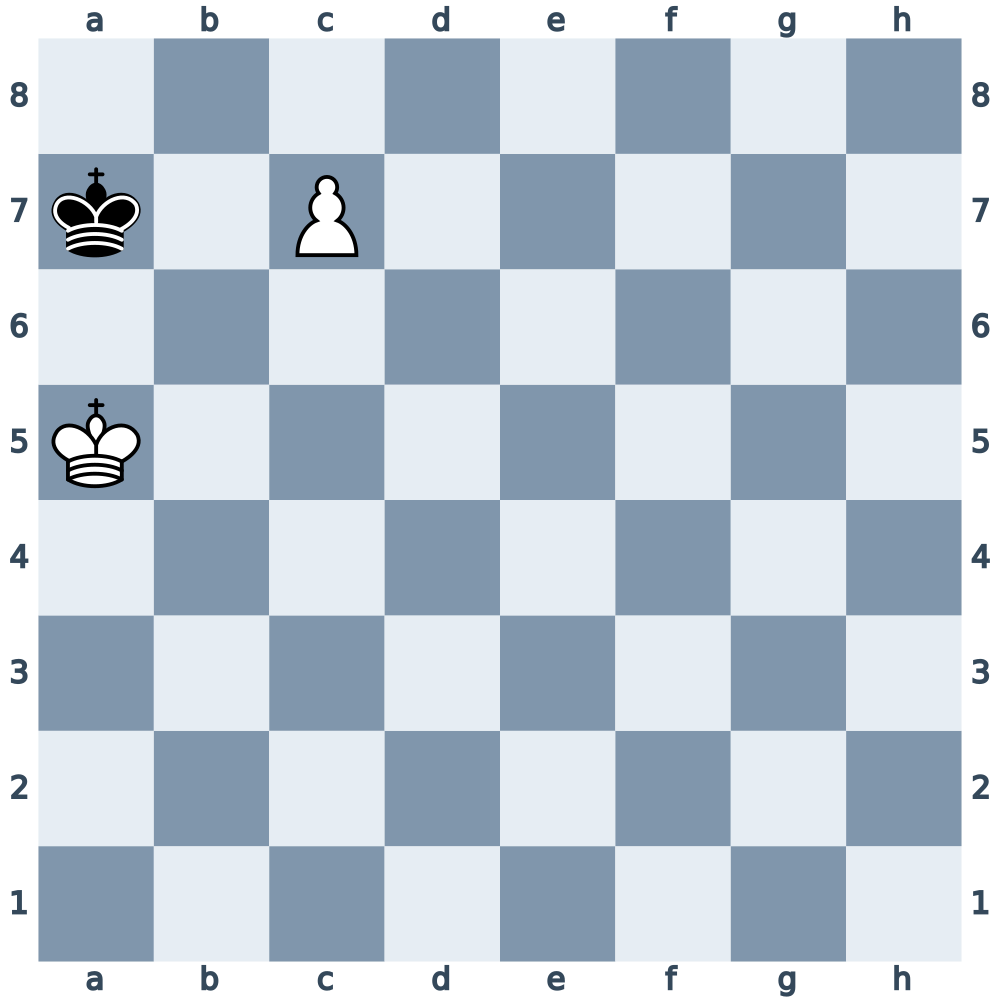
Position A: White have Ka5 and Pc7; Black have Ka7. Which promotion wins?
Position B: White have Kc6, Pc7 and Pa5; Black have Ka7, Rd8 and Pa6. Choose the promotion after capturing the rook.
Solution A: 1.c8=R! leaves b7 available to Black’s king. Promotion to a queen is stalemate. Promotion to a bishop or knight leaves insufficient mating material; 1.c8=N+ is a check, but still a draw.
Solution B: 1.cxd8=N! preserves a winning ending. Queen and rook promotions are stalemate. Bishop promotion leaves the wrong bishop for the a-pawn: the bishop on d8 cannot control a8, and the position is drawn with correct defense. Black can answer the knight promotion with …Ka8 or …Kb8.
A checklist before promoting
- Is the promotion legal, and does it give check?
- If it is not check, does the opponent have any legal move? Count pawn and piece moves as well as king moves.
- Can the promoted piece be captured, or can the opponent make a forcing counterattack?
- Would a knight give a useful check or fork that a queen cannot?
- If I choose a smaller piece to avoid stalemate, is the resulting endgame still winning?
Usually, take the queen. But make that choice after calculation, not before it. Underpromotion is a practical reminder that the result depends on the position of the pieces, not simply on their nominal value.
Further practice
Practice these positions on a board before checking them with a tablebase. Explain why the rejected promotions fail, not just why the chosen move works.