By GM Ulvi Bajarani, Founder and Head Coach of Azeri Chess Academy
An engine can identify a losing move. It cannot tell you what you were thinking when you played it. That difference matters: finding the correct move is one task; changing the habit that produced the mistake is another.
Before looking at an evaluation bar, give yourself a chance to investigate. Record your thoughts, choose a critical position, examine alternatives, and only then compare your conclusions with computer analysis. Finish with something specific to practice—not merely a list of mistakes.
1. Save your thoughts before seeing the answer
Replay your game with computer assistance switched off. Hide the evaluation bar, suggested moves and automated move labels. If possible, do this while your decisions are still fresh. A longer game is especially useful because you are more likely to remember meaningful choices rather than a sequence of rushed moves.
Write down what you actually remember: the move you expected, the threat you noticed, the alternatives you rejected, and where you felt uncertain. If you do not remember, say so. Separate “during the game” from “found during review.” Otherwise, a discovery made afterward can quietly become something you believe you saw at the board.
Your notes do not need to sound impressive. “I thought the knight was free” is useful information. “I played badly” is not: it says nothing about the decision. Record a concrete thought that can be tested against the position.
NM Anthony Levin demonstrates this distinction by presenting his own pre-computer annotations before comparing them with engine analysis. The value is not that the original notes are correct; it is that they preserve an honest record of what was and was not understood.
2. Choose a position worth investigating
You do not need to explain every move. Start with a moment when you made a major commitment, felt surprised by the reply, spent a long time without finding a plan, or changed your assessment of the position. Captures, pawn breaks, exchanges and decisions about king safety are natural places to look.
The last mistake is not always the most useful one. If you lost a piece on move 30, the more instructive decision may have been accepting a difficult position several moves earlier. Conversely, do not search for a deep strategic explanation when a simple overlooked check decided the game.
At the chosen position, pause and describe the board before calculating: whose king is more exposed, which pieces are active, what is attacked, and which lines could open? These observations should guide candidate moves, not replace calculation.
3. A worked example: Réti–Tartakower
Richard Réti–Savielly Tartakower, Vienna 1910, gives us a short example with a clear decision to examine. We will review it from Black’s perspective. The questions below are a learning exercise—not a reconstruction of Tartakower’s private thoughts.
The game began: 1.e4 c6 2.d4 d5 3.Nc3 dxe4 4.Nxe4 Nf6 5.Qd3 e5 6.dxe5 Qa5+ 7.Bd2 Qxe5 8.O-O-O.
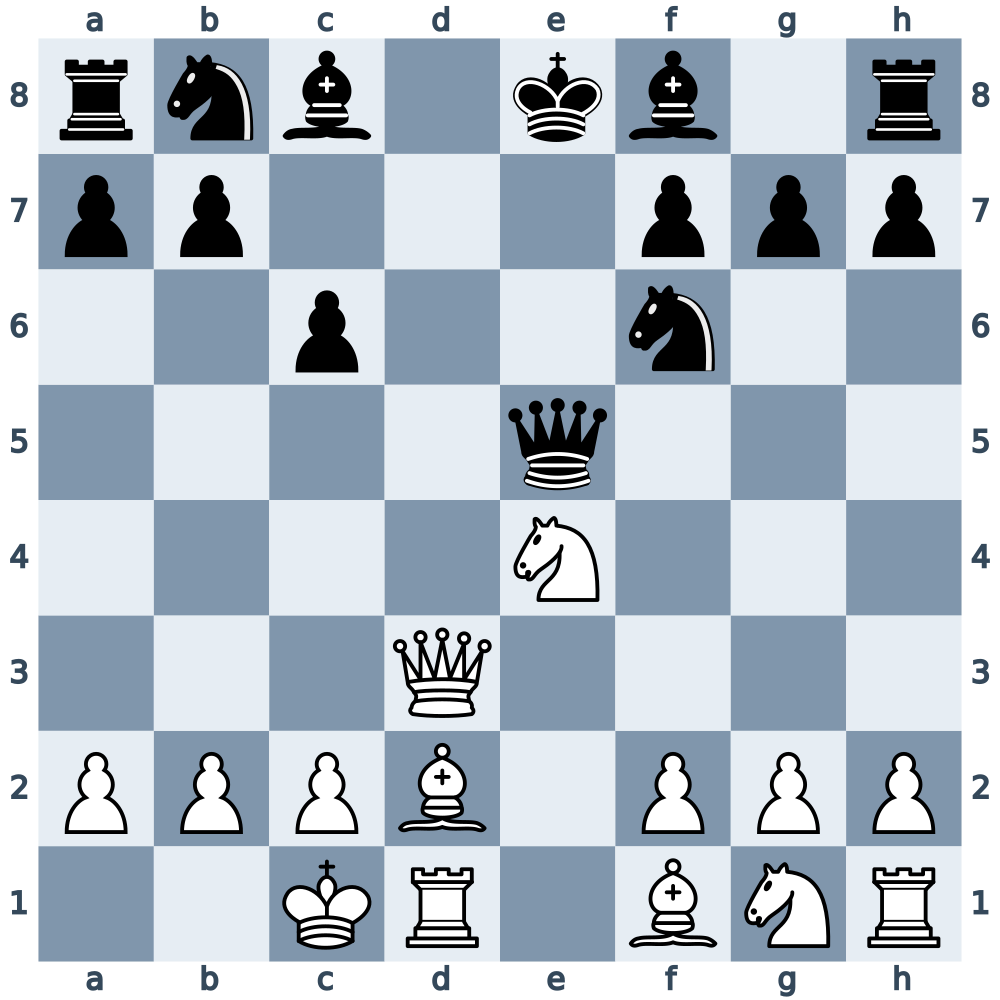
Black can capture the knight on e4 with 8…Nxe4. Before deciding whether this wins material, ask what White’s last move changed. Castling brought the rook to d1. White’s queen stands on d3 and the bishop on d2, so the rook does not yet have a clear line toward Black’s king. Those pieces can move, however. A blocked line can become dangerous very quickly.
Black’s king is still on e8, the kingside bishop remains on f8, and the queenside pieces have not developed. Also notice the knight on f6. If it moves to e4, it vacates a square on the diagonal g5–f6–e7–d8. That detail will matter more than the material gained.
This is the right point for a review question: “After I capture, what forcing move can my opponent play?” Do not limit the search to ordinary recaptures. A capture may be tactically impossible even when the capturing piece cannot immediately be taken back.
4. Calculate the opponent’s strongest response
In the game, Black played 8…Nxe4? Before reading on, look for White’s checks. Try to calculate a complete line rather than stopping at an attractive first move.
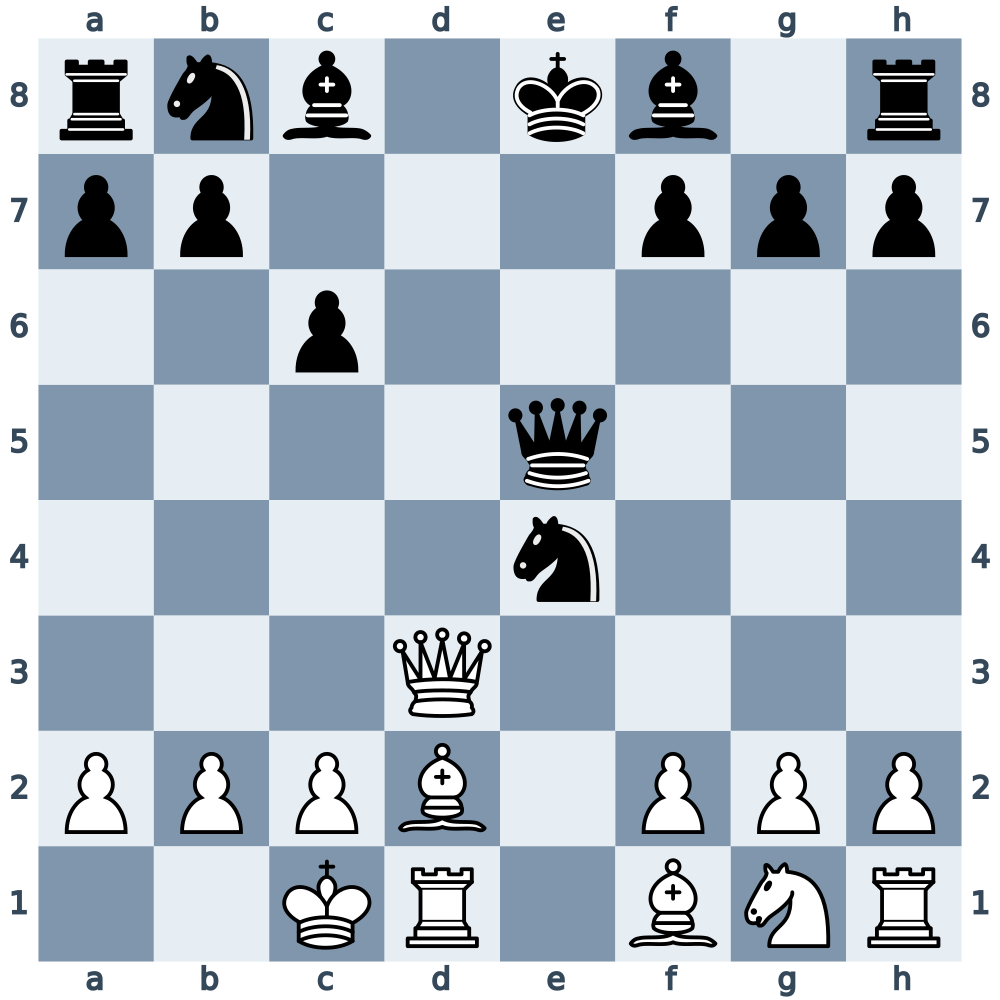
White have 9.Qd8+! The queen moves along the d-file and offers herself to the king. Black’s only legal reply is 9…Kxd8. Now 10.Bg5+ produces a double check: the bishop checks along g5–f6–e7–d8, while its departure from d2 opens the rook’s line from d1 to d8.
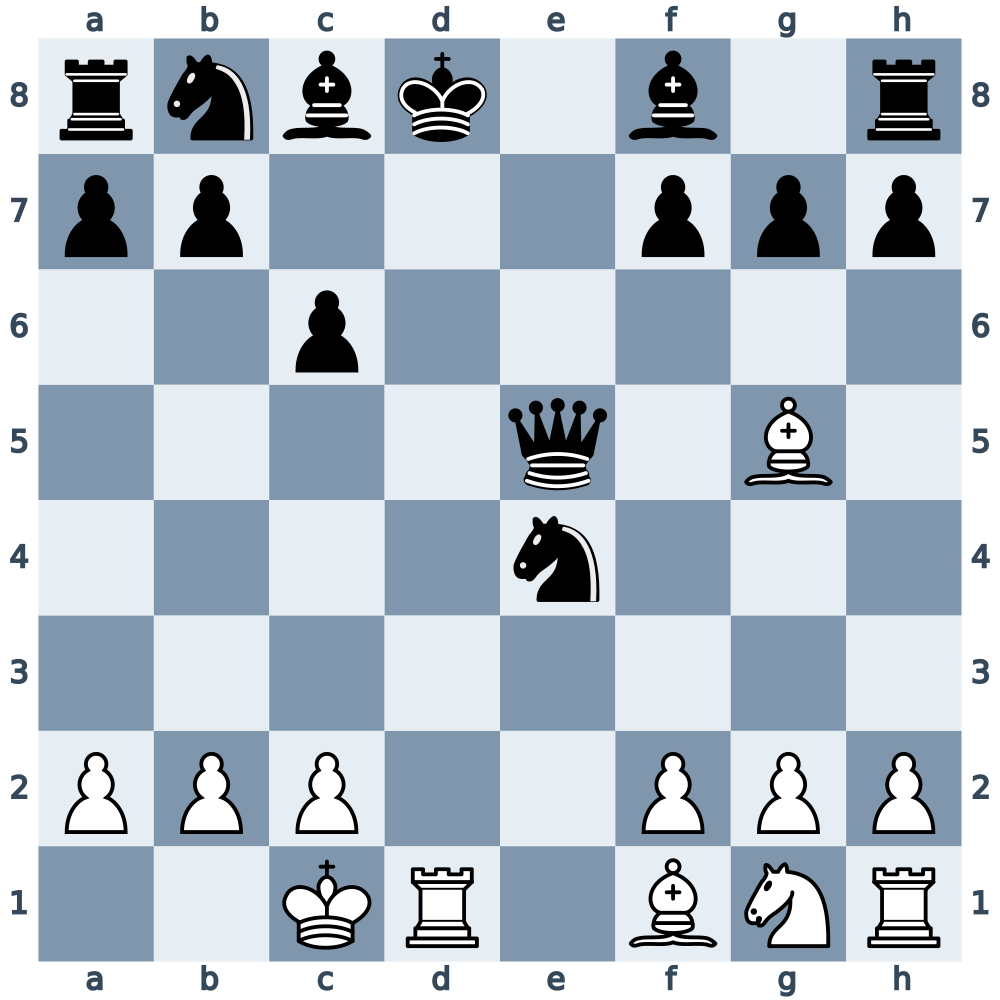
A king move is required against this double check. Black have exactly two legal replies: 10…Ke8 and 10…Kc7. After 10…Ke8, White play 11.Rd8#. After 10…Kc7, White play 11.Bd8#. In the second line, the bishop leaves the d-file blocked again, but its diagonal to c7 delivers mate; the rook on d1 protects the bishop on d8.
The contemporary score ends with 10.Bg5+ and Black’s resignation. The two mating finishes above explain the resignation; they are analytical continuations, not additional moves from that score.
Now go back to the decision on move eight. “I missed a queen sacrifice” describes the move that was overlooked. A more useful board explanation is that the capture left the king exposed to a forcing sequence, opened a critical bishop diagonal, and allowed the rook on d1 to join the attack.
For your own game, investigate the thinking error separately. Did you stop calculating after winning material? Did you examine only recaptures? Did you notice the rook but assume the blocking pieces would stay in place? Only your remembered notes can answer those questions. The position itself cannot prove what you were thinking.
5. Test alternatives, then use the engine
Return to Diagram 1 and look for alternatives before turning on the engine. Besides 8…Nxe4, consider three candidates: 8…Qxe4, capturing with the queen; 8…Be7, developing the kingside bishop; and 8…Nbd7, developing a knight. Each needs a concrete reply, not just a general explanation.
The other capture, 8…Qxe4?, allows 9.Re1! The rook creates an absolute pin along the e-file: Black’s queen on e4 stands between the rook on e1 and the king on e8. The queen cannot leave the file while that would expose the king to check. White threaten to capture it with Rxe4.
Black can obtain compensation, however. After 9…Qxe1+ 10.Bxe1, White have won the queen, but Black have captured a knight and a rook in exchange. Thus this is not a free queen. The alternative 9…Qe7 also fails to save it: 10.Rxe7+ Bxe7 produces the same material exchange. Cached engine analysis favors 9…Qxe1+ as the best defense after 9.Re1 and still assesses White as better. The practical lesson is to check whether a capture places a valuable piece in front of its own king on a line an opposing rook can occupy.
After 8…Be7, examine 9.Nxf6+ Qxf6 10.Nf3 O-O. Black have developed the bishop and brought the king out of the center. This is an illustrative continuation, not a claim that White must choose every move in it. Its purpose is to identify what Black can achieve instead of immediately taking the knight.
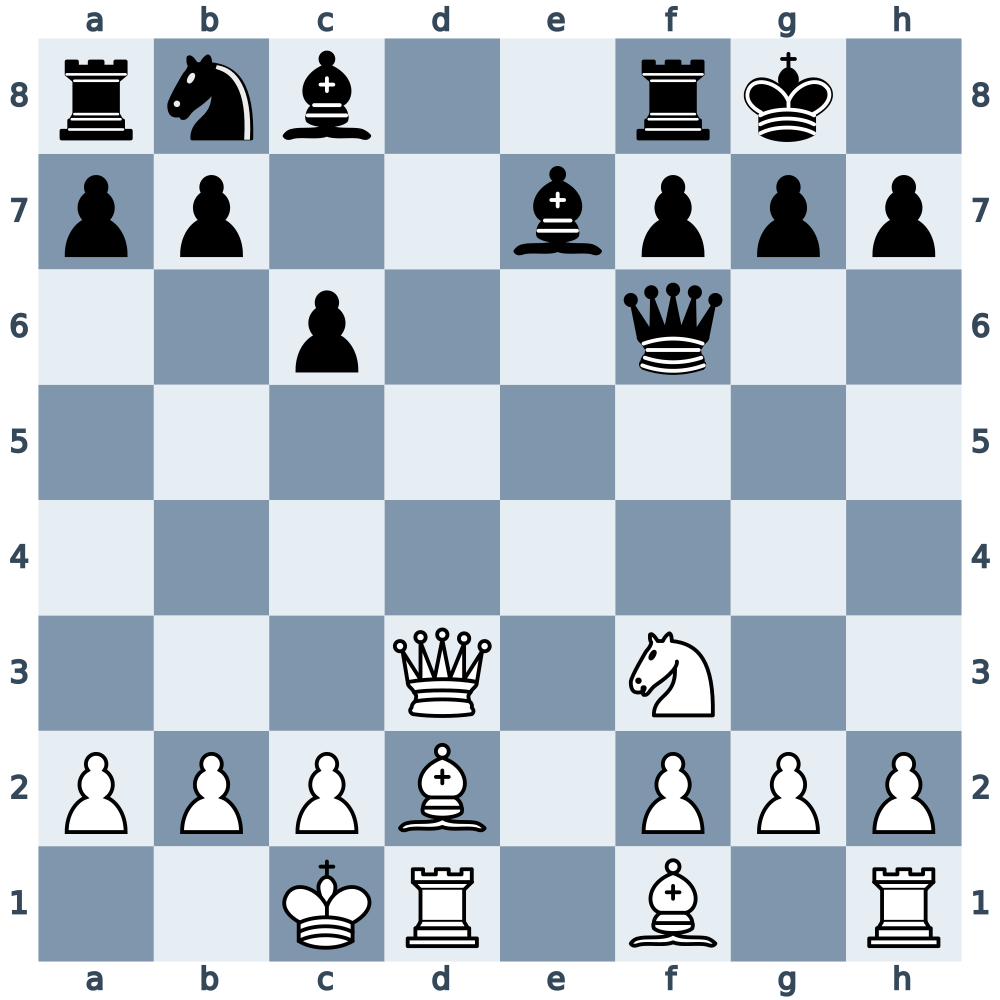
The knight-development candidate illustrates why a developing move still needs calculation. After 8…Nbd7, White have 9.Re1! Consider 9…Nc5 10.Nxf6+ gxf6 11.Rxe5+: White win the queen. This is one concrete branch, not a forced account of all Black’s defenses. It exposes a tactical problem that the phrase “develop a piece” does not solve.
Now use an engine to test your conclusions. Ask specific questions: Does the queen sacrifice force mate? Was Black already worse before the capture? Which candidate offers the better defense? Examine the suggested replies on the board, including the opponent’s resources, rather than copying an evaluation.
For this example, cached Lichess cloud analysis confirms mate in three after 8…Nxe4, starting with 9.Qd8+. Its analysis of the earlier position favors 8…Be7, while still assessing White as better. A separate cached analysis also finds 8…Nbd7 substantially worse. The correction is therefore not “Black could equalize simply by developing.” It is “Black could avoid the immediate mating combination and offer better resistance with 8…Be7.”
These checks used stored cloud analysis, not a newly run engine session. Search depths differ between positions, so small numerical comparisons would add little here. The important distinction is between a forced mate, a better defensive choice, and a superficially natural move that still has tactical defects.
6. Turn the review into one practice task
A practical lesson from this game is: before accepting material with your king in the center, check the opponent’s forcing moves and inspect the lines your move opens. This is more actionable than “be careful,” and more transferable than memorizing 9.Qd8+.
For practice, reset Diagram 1. Explain aloud what changes after 8…Nxe4, then calculate the queen sacrifice through both king replies without moving the pieces. Finally, play the moves on a board to check your calculation. Repeat later from memory of the ideas, not merely the move sequence.
In your next serious game, use the lesson when a similar decision appears. Ask whether a tempting capture changes a defensive line or exposes your king. Do not force this particular combination onto unrelated positions: the useful habit is the safety check, not an expectation that every position contains a queen sacrifice.
GM Noël Studer emphasizes focused analysis of a few understandable moments rather than trying to absorb every improvement an engine proposes. If a position remains unclear, save a precise question for a coach or stronger player. A question such as “Why is this exchange unfavorable?” is easier to investigate than “What went wrong in the whole game?”
Not every review should end with a tactical exercise. In a quiet game, you might discover that you exchanged your active piece, left an opponent’s pawn break unanswered, or entered an ending you did not understand. Then compare plans, pawn structures or endgame methods. Use calculation to test those ideas, but do not reduce every mistake to a missed combination.
7. A reusable game-review checklist
- Record: What did I actually think during the game? What am I discovering only now?
- Select: Which decision deserves closer attention, and why?
- Observe: What changed in king safety, piece activity, targets or open lines?
- Calculate: What are my candidates, and what is the opponent’s strongest response to each?
- Verify: Which conclusions survive engine checking? Which questions remain unresolved?
- Practice: What one habit or chess skill will I work on next?
Keep the original notes beside the corrected analysis. The difference between them is often the most valuable part of the review. You are not trying to prove that you could have played perfectly. You are trying to understand one decision well enough to approach the next similar decision differently.
Sources and analysis notes
NM Anthony Levin: How to Annotate Your Games to Improve at Chess
GM Noël Studer: The Right Mindset for Game Analysis
Edward Winter: Réti v Tartakower, Vienna, 1910 — historical score and contemporary sources
Lichess cloud-analysis API documentation
Analysis checked on 20 October 2026. Cached search depths: before 8…Nxe4, 38; after 8…Nxe4, 60; after 8…Be7, 25; after 8…Nbd7, 19; after 8…Qxe4 9.Re1, 25. All diagram positions and printed continuations were checked for legal moves; both mating branches were checked through the final position.