
By GM Ulvi Bajarani, Founder and Head Coach of Azeri Chess Academy
Your first over-the-board chess tournament will feel more manageable if you know what happens before, during and between games. Choose an event that welcomes players at your level, rehearse its practical routines and arrive with a simple plan. You do not need a large memorized opening repertoire to take that first step.
This guide is for adult beginners and parents preparing a child for a first in-person event. It uses US Chess tournaments as its main reference. Other federations and organizers may apply different rules. Check the current event announcement and ask the tournament director, usually called the TD, about anything unclear.
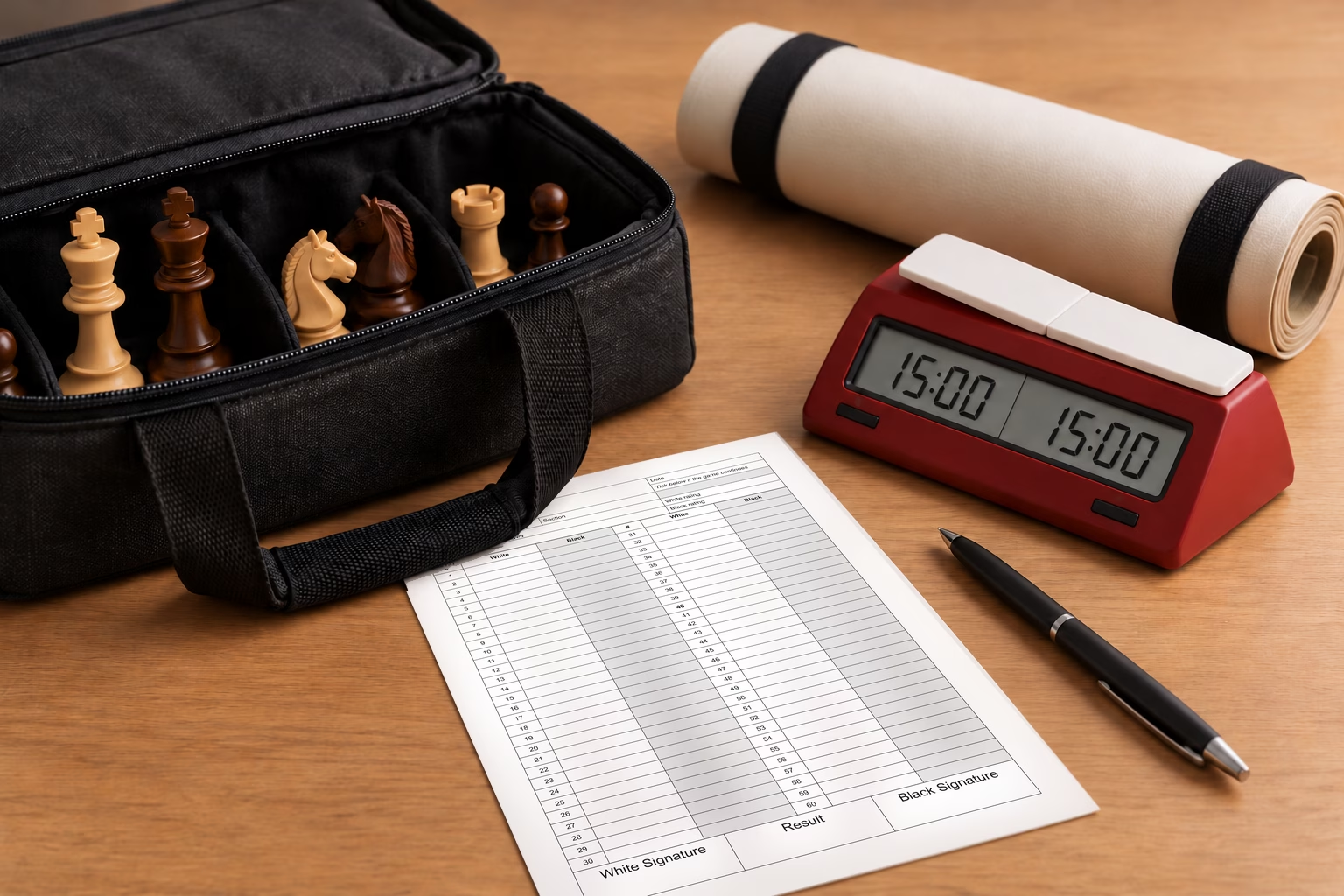
Decide whether you are ready
Start with a practice game rather than a rating target. Can you set up the board correctly, play legal moves and recognize check, checkmate and stalemate? Review castling, promotion and en passant so these situations do not become surprises. You should be able to finish a game without someone telling you what to play.
Readiness also includes the routine around the moves: sitting quietly while an opponent thinks, handling a clock, following instructions and asking an official for help. You do not need to do everything perfectly. Identify what still feels unfamiliar and rehearse it before registering.
For a child, consider whether they want to compete and can manage the expected game length independently. A suitable first event depends on the child and the event, not a single recommended age. Ask the organizer about eligibility, parent access and any accommodations you need before paying.
Start with casual games
Before entering a formal tournament, play casual games with patient, friendly opponents. A club session, community meetup or game with a friend gives you space to ask questions without worrying about a result. This is especially helpful for a child who has mostly played at home or online.
Introduce the practical skills gradually. First get comfortable moving pieces on a physical board. Then add a clock and practice recording the moves. Pause between practice games to correct mistakes and ask questions. Once these routines feel familiar, play complete games under tournament conditions.
For local starting points, Jim Liptrap’s Houston Chess Tournament Schedule includes weekly activities and a link to casual chess locations as well as tournaments. Check the current details with the organizer before your first visit. [9]
Choose an event and section that fit
Many Houston-area events are geared toward children. Look for scholastic events, whose sections commonly use grade limits such as K-8 or K-12. Those are school-grade ranges, not ages. Some events also offer separate open or adult sections, so read the section details rather than relying on the event title. [9]
JTP means Junior Tournament Player, a US Chess membership-exception program, not a general age or grade division. Eligible children can play in designated JTP events without paid US Chess membership, but still need a US Chess ID. Ask the organizer about the specific eligibility restrictions. Adults cannot play in JTP sections. [10]
Look for an event that explicitly accepts beginners or unrated players. Ask which section you may enter and which rating the organizer uses. “Unrated” does not necessarily mean “beginner,” and an online rating is not automatically interchangeable with an official over-the-board rating. Disclose other ratings when requested. [1]
Check the format. In a Swiss tournament, losing a game normally does not eliminate you; later pairings generally bring together players with similar tournament scores. Expect to keep playing the scheduled rounds, not to go home after one loss. [2]
Choose a time limit that gives you room to think and handle the practical tasks. For clock terminology, read our chess time-controls guide. [3]
For Houston-area tournaments, begin with Jim Liptrap’s Houston Chess Tournament Schedule. [9] The US Chess directory and Texas Chess Association listings are useful secondary resources. [4, 5] Always check the date and the organizer’s current announcement before registering.
Confirm the details before you pay
An entry fee and a federation membership are different things. Current US Chess membership is normally required for US Chess-rated play, with exceptions. Confirm what your event requires, whether membership is included, and whether you need a state association membership. [1]
Check these details before paying, and save your confirmation after registering:
- Eligibility, section placement and any school-grade, age or rating limits.
- Check-in deadline, all round times, the likely finish and travel or parking needs.
- Entry and late fees, memberships, and cancellation or refund terms.
- Supplied equipment, the clock setting, notation rules and the device policy.
- Parent access, waiting areas, food arrangements and where to meet after a game.
Ask about requested byes if you have a schedule conflict; their availability, deadlines and scoring vary. Notify the TD before missing a round or withdrawing. [6]
Rehearse the tournament routine at home
After casual practice, play complete games on a physical board with the event’s time control. Put your phone away, avoid takebacks and finish the game even after losing material. Notice whether handling the clock or writing moves distracts you, then rehearse the awkward part again.
Practice basic algebraic notation and replay a game from your own scoresheet to check that it is legible. For chess study, use familiar openings, review basic checkmates and look for your opponent’s threats before moving. Check for forcing moves and undefended pieces on both sides.
Verify castling before making the move
Before castling, check that neither your king nor that rook has moved, every square between them is empty, and your king is not in check. The king must not cross or finish on an attacked square. [11] Verify these conditions in the actual position, even when castling looks routine; experienced players can overlook them too.
Know when recording moves is required
US Chess Regular and Dual-rated games normally require recording both players’ moves. With increment or delay below 30 seconds, both may stop once either has less than five minutes in the current time-control period. In sudden death this lasts for the rest of the game; otherwise recording resumes in the next period. US Chess Quick-only and Blitz games normally do not require notation. [6]
With a US Chess increment or delay of 30 seconds or more per move, notation normally continues even in time trouble. The 30-second delay rule is important: do not assume only an increment counts. [12]
In FIDE standard chess, only the player whose own clock is below five minutes may stop recording, and only without an increment or delay of at least 30 seconds per move. With 30 seconds or more, recording normally continues. FIDE rapid and blitz do not require players to record moves. [11]
The boundary is strictly less than five minutes, not five minutes or less. At exactly 5:00, the time-pressure exemption has not begun. [6, 11]
Ask which rules govern the event rather than deciding from a label such as “rapid” alone. Confirm permitted recording materials, section exemptions and approved accommodations beforehand. National scholastic events, for example, have section-specific notation requirements and exceptions. [7]
Keep the final evening simple: pack, confirm the route and get a normal night’s rest. Avoid a last-minute study marathon.
Know the procedures that matter
For US Chess play, keep these procedures in mind: [6]
- Touch-move: deliberately touching to begin a move can oblige you to move or capture that piece, if legal. Say “I adjust” before straightening a piece on your turn.
- Draw offers: if the event permits them, make your move, offer the draw, then press your clock. Do not interrupt your opponent’s thinking with an offer. [11]
- Clock use: move the piece and press the clock with the same hand. [11]
- Devices: check permitted devices, storage and penalties; these vary by event.
- Problems: for a legitimate rules or conduct issue, stop both clocks and call the TD.
- Parents: do not prompt moves or clock use, or make claims for your child.
Rehearse asking for help in plain language: “I think there is a problem with the position. Could you help us?” A first-time player should know whom to ask without feeling they must already know the ruling.
Pack the night before and arrive with time to settle
Bring only the equipment the organizer asks for: a board and pieces, a suitable clock if needed, and permitted writing supplies. Know how to set your clock, but ask an official if the required setting is unclear. Pack water, a simple snack for permitted areas and a light layer for the playing room.
Save your membership number, registration confirmation, organizer contact details and venue address. Check parking and the correct entrance. Allow a buffer before the check-in deadline for traffic, finding the room and a restroom visit. Online registration does not tell you whether a separate arrival check-in is required; verify it.
Find your pairing, board number and assigned color before each round. Confirm you are seated opposite the correct opponent, with the board ready and the expected clock setting. Listen to announcements rather than assuming each round follows the same routine.
Manage the day one game at a time
Pick a process goal you can control: checking for threats before moving, taking time in unfamiliar positions or staying attentive after a mistake. Your first tournament gives you experience to build on; a result alone cannot tell you everything about how you played.
If nerves rise, pause, breathe slowly and return your attention to the position. You do not have to match an opponent’s speed. A quick reply is not proof that their move is strong.
Confirm and promptly report the result using the event’s required method. [6] Then leave the playing area quietly. Take a break, have some water and check when to return. Save a long analysis session for later if the next round is close.
Parents can help most by keeping the breaks calm. Ask, “Would you like to talk about the game now or later?” Praise a specific effort or habit rather than immediately asking why a move was missed. Agree on a meeting place in advance so a child knows where to go after finishing.
Turn the experience into your next training plan
Keep the games you recorded. When you are rested, replay them without an engine first and mark the moments where you felt unsure, rushed or surprised. Write a brief note about what you considered. Your thinking is useful evidence even when the move itself was a mistake.
Choose one or two recurring issues to work on. Perhaps you missed undefended pieces, spent too long on familiar opening moves or stopped looking for your opponent’s threats when ahead. Set up those positions again and work through better decisions. A coach can help separate a tactical gap from a time-management or thinking habit.
Review the event choice too. Was the game length manageable? Did the schedule suit you or your child? Did you have enough time for food and breaks? Use those answers to choose the next tournament rather than rushing into a harder or longer event.
Frequently asked questions
Do I need a rating before my first tournament?
Not necessarily. Look for an event that accepts unrated players and confirm your eligible section. Do not assume that every rating-limited section accepts unrated entries. [1, 7]
Will I be eliminated if I lose?
Usually not in a Swiss tournament. You normally continue through the scheduled rounds. Check the event format, since a knockout event works differently. [2]
Does my child have to write down every move?
Check the governing rules, time control and section exemptions explained above. Practice recording beforehand when required, and ask about permitted scoresheets or recording materials. Do not assume that a young or unrated player is automatically exempt. [7]
Do I need to buy a tournament set and clock?
Ask what the organizer supplies before buying anything. If you must bring equipment, confirm what is acceptable and practice with it beforehand.
How long will the tournament take?
Use the full round schedule, not the time you usually spend on an online game. Allow for breaks, long games, possible delays and any closing activities you want to attend.
Get help with your first tournament
If you would like guidance choosing a suitable event or preparing for the practical demands of tournament play, explore Azeri Chess Academy’s private chess coaching in Houston or online. Share your current experience, the event you are considering and the areas you would like to work on. Ask about available lesson formats and coaching options. [8]
Use the checklist below to turn your preparation into a few concrete steps.
First tournament checklist
Event: ____________________ Date: ____________________
Section: ___________________ Check-in by: _______________
Venue: __________________________________________________
Organizer contact: _______________________________________
Before registering
- Confirm the right section, including grade limits and any JTP eligibility.
- Confirm membership, entry fees and refund terms.
- Check all rounds, check-in, the venue and travel plans.
- Ask about equipment, notation, devices and spectator access.
- Resolve any schedule conflicts or accommodation needs with the organizer.
Before tournament day
- Start with casual games, then rehearse with a board and the event’s clock setting.
- Practice notation and learn when your event requires it.
- Review castling rights, the clear path and the king’s safe squares.
- Practice draw-offer timing and same-hand movement and clock use.
- Learn how to ask the tournament director for help.
- Pack required equipment, permitted writing supplies, water and snacks.
- Save confirmation details and allow time to arrive before the deadline.
At the venue
- Complete any required check-in and listen to announcements.
- Find the correct board, opponent and color.
- Follow the device policy and keep the playing area quiet.
- Report each result and check the next round’s start time.
- Take a break; parents and children meet at the agreed place.
After the event
- Keep your scoresheets and note what felt difficult.
- Review a few important positions when rested.
- Choose one or two skills to practice before your next event.
Sources and official guidance
General preparation suggestions are coaching advice, not tournament regulations. Event requirements can change. Consult the current organizer announcement and the applicable federation rules. Source review date: October 19, 2026 (Houston).
[1] US Chess: Tournament Director and Affiliate Frequently Asked Questions
Membership requirements and other ratings; revised September 30, 2026.
[2] US Chess: New to National Events
Swiss format; national-event procedures are not universal.
[3] Azeri Chess Academy: Chess Time Controls
Companion guide to clock terminology.
[4] US Chess: Upcoming Tournaments
Secondary discovery resource; confirm current organizer details.
[5] Texas Chess Association: TCA and TCA Club Tournaments
Secondary Texas listings; check dates and current announcements.
[6] US Chess: Official Rules of Chess, online edition, January 1, 2026
Touch-move, notation, withdrawals, results, spectators, devices and TD assistance.
[7] US Chess: National Scholastic Chess Tournament Regulations, 2026-2027
National-event eligibility, notation requirements and exceptions.
[8] Azeri Chess Academy: Private Chess Coaching in Houston
Current private-coaching options and inquiry information.
[9] Jim Liptrap: Houston Chess Tournament Schedule
Primary local starting point; includes weekly activities and casual-chess resources.
[10] US Chess: Junior Tournament Player Event Information, 2026 revision
JTP membership exceptions and eligibility restrictions.
[11] FIDE: Arbiters’ Manual 2026
Laws of Chess and commentary: castling, notation, rapid/blitz, and increment/delay.
[12] US Chess: Just the Rules – Some Rulebook Updates Coming in 2024
The 30-second delay notation rule, checked against the 2026 rulebook.