By GM Ulvi Bajarani, Founder and Head Coach of Azeri Chess Academy
Choosing how long to play matters when you are learning chess. A game that ends before you can examine your opponent’s threats gives you little opportunity to practice a careful thinking process. A slower game gives you more time, but you still need to use that time deliberately.
This guide explains clock notation, the differences between common playing speeds, and why the same time control can receive different labels. It also compares over-the-board, online and hybrid play. For beginners, my recommendation is to make slower rapid games the main form of practice and review them afterward, rather than concentrating on the number of games played.
How to read a chess time control
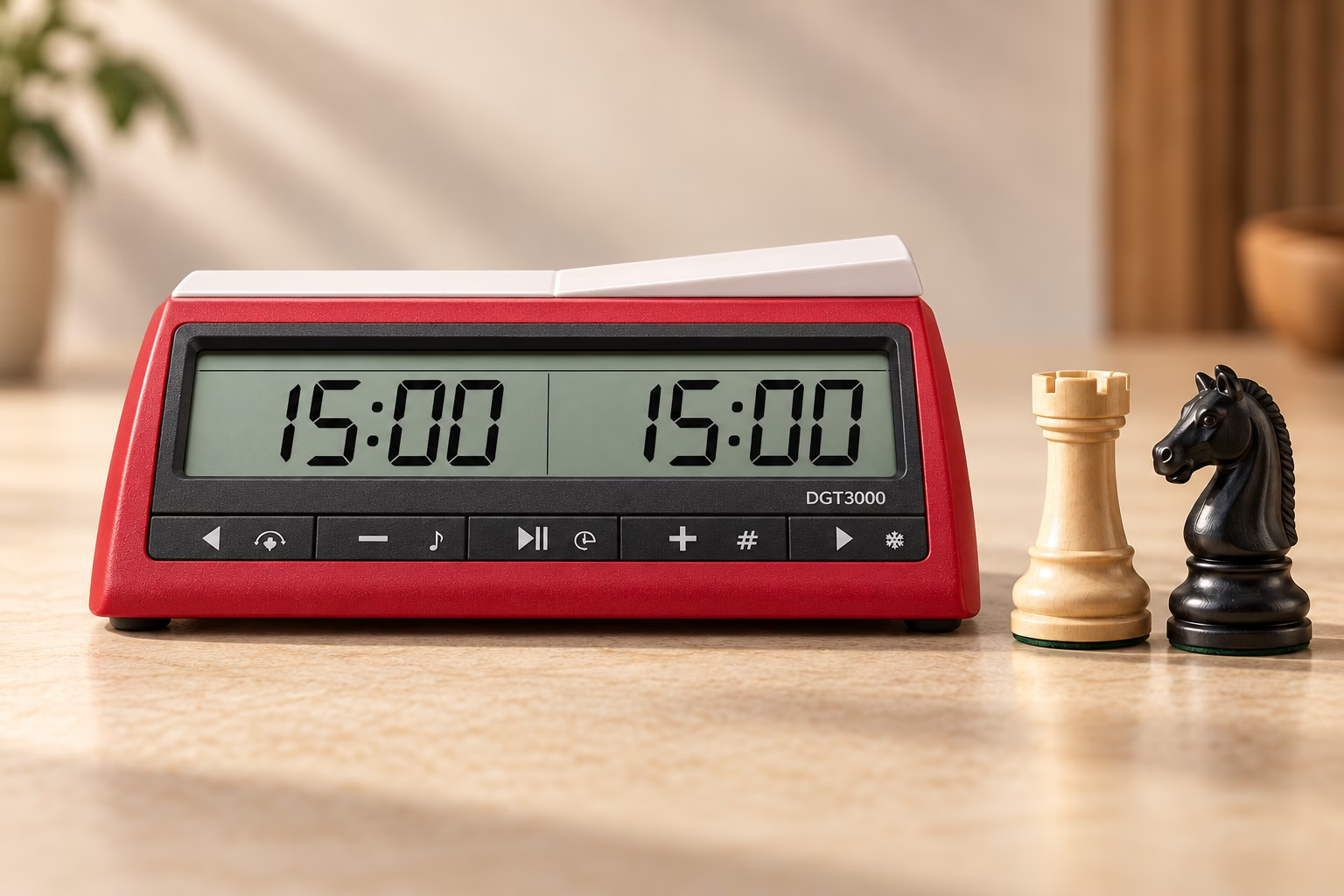
The stated starting time normally belongs to each player, not to both players together. At 10+0, White start with ten minutes and Black start with ten minutes. Thinking time comes from the clock of the player whose turn it is.
| Notation | Meaning for each player |
|---|---|
| 10+0 | Ten minutes for the game, with no added time per move. |
| 15+10 | Fifteen minutes initially, plus a ten-second increment per move. |
| G/30 d5 | Thirty minutes for the game, with a five-second delay on each move. |
Increment and delay are different
An increment adds time for each move. With a ten-second increment, spending three seconds on a move and then completing it produces a net gain of seven seconds compared with the time before that turn. A delay gives a grace period before the main time is used. With a ten-second simple delay, a three-second move leaves the main time unchanged; unused delay does not accumulate. [1]
Clock settings and displays differ. Confirm whether an event uses increment, simple delay or another supported delay mode, and follow the organizer’s clock-setting instructions. Do not assume that a plus sign and a letter d mean the same thing.
Why the labels can be confusing
FIDE, US Chess and online platforms do not use identical categories. A label such as rapid is meaningful only when you know whose system is being used. For a tournament, read the published regulations and rating information rather than relying on the name alone.
FIDE time categories
For the rapid and blitz definitions in the FIDE Laws, the calculation includes the starting time plus 60 times any increment or delay. Blitz is ten minutes or less per player; rapid is more than ten minutes but less than 60 minutes. These are classification calculations, not predictions of the game’s actual duration. [1]
| Example | FIDE calculation and classification |
|---|---|
| 10+0 | 10 minutes: blitz. |
| 15+10 | 15 minutes + 60 × 10 seconds = 25 minutes: rapid. |
| 90+30 | 90 minutes + 60 × 30 seconds = 120 minutes: outside rapid and blitz, commonly described as classical. |
A 90+30 game does not have to end after 60 moves, and 120 minutes is not its fixed duration. Players may finish much sooner, or play more moves and receive further increments. The calculation is per player; it is not the total time for both players combined.
Classical is a familiar description for slower chess. However, a time control outside the rapid and blitz definitions does not automatically qualify a tournament for FIDE standard rating. Standard-rating eligibility has additional minimum-time requirements that depend on the players’ ratings, as well as other event requirements. [2]
US Chess rating categories
US Chess uses different boundaries. For these classifications, add the starting minutes to the number of increment or delay seconds: G/30 d5 gives 30 + 5 = 35. This shortcut corresponds to a 60-move allowance. The table describes rating categories, not a guarantee that an event is rated. [3]
| Calculated value | US Chess rating category |
|---|---|
| 5 through 10 | Blitz, with at least three minutes of base time. |
| More than 10, less than 30 | Quick only. |
| 30 through 65 | Dual rated: both Quick and Regular. |
| More than 65 | Regular only. |
Longer controls and event schedules
Sudden death and non-sudden-death periods
A sudden-death period gives a player a time allowance for all remaining moves, with any stated increment or delay. The term does not mean that the game must be fast: G/90 is a sudden-death control even though each player starts with 90 minutes.
A non-sudden-death period instead requires a specified number of moves within an allotted time. A multi-period control can begin with one of these periods and finish with a sudden-death period. Read the complete control, not just the first number. [1]
Example: 40 moves in 90 minutes, then 30 minutes for the rest of the game, with a 30-second increment from move one. [8]
Here, each player must complete 40 moves within the first-period allowance, including the increments received. After the first time control, another 30 minutes is added; any unused time carries forward. The second period covers all remaining moves, and the 30-second increment continues.
The first 90 minutes therefore does not describe the entire game allowance. Nor does reaching move 40 end the game: it ends the first period. Before playing, confirm when the clock adds the next period and whether its move counter requires special attention. If something appears incorrect, ask the arbiter rather than attempting to resolve the clock issue yourself.
Daily playing limits
For FIDE standard-rated events, scheduled playing time must not exceed 12 hours in a day, calculated by assuming 60 moves per game. This counts the time available to both players together. At 90+30, the estimate is two hours per player, or four hours for the round. This is a scheduling calculation, not a rule that a game must finish after 60 moves or exactly four hours; games with increments can last longer. [2]
Preparing for a known opponent
Longer-event schedules often provide time to prepare once the pairings are known. You can review an opponent’s available games, consider likely openings and refresh relevant ideas before the round. This opportunity depends on the schedule and when pairings are released; it is not exclusive to classical chess.
Preparation takes place before the game. It does not authorize consulting notes, an engine or another person during play. For beginners, a brief review of familiar ideas is usually more useful than trying to memorize a large amount of new analysis just before a round.
Bullet and online speed categories
Bullet and ultrabullet are mainly online labels for very fast games. Their precise boundaries vary by platform, so there is no single universal definition to apply to every website. Check the site’s own categories when choosing a game or comparing ratings.
Online platforms can also use a different estimate for increment. Chess.com uses a 40-move calculation for its live-chess rating categories; Lichess also uses a 40-move estimate, with its own speed boundaries. At 15+10, that estimate is 15 minutes plus 400 seconds, or 21 minutes 40 seconds, rather than the 25-minute FIDE calculation. [4, 5]
A useful boundary example is 10+0: it is blitz under the FIDE definition, but rapid on Chess.com and Lichess. The clock has not changed; the category has. Avoid comparing ratings across platforms or speed categories as though they were the same scale. [1, 4, 5]
What each speed lets you practice
Bullet and ultrabullet
Common examples are 1+0 for bullet and 15 seconds with no increment for ultrabullet, subject to the platform’s labels. At very short time limits, execution speed and familiarity with positions become especially important. I do not recommend making these games part of a beginner’s main improvement plan. They leave too little room to practice checking threats, comparing candidate moves and calculating captures. Playing them for enjoyment is different from choosing them as structured training.
Blitz
Typical blitz choices include 3+2 and 5+0. Blitz allows several games in a short session, but beginners can easily repeat the same mistakes without understanding them. Experienced players may use it to test familiar opening ideas, recognize recurring positions or regain practical sharpness. That practice is more useful when the games are reviewed; blitz results alone do not establish that an opening or decision was sound.
Rapid
Rapid usually offers a better compromise between thinking time and convenience. A beginner can practice a deliberate decision process without committing to a long tournament game. Nevertheless, choosing rapid does not help much if every move is played instantly. Use the available time, especially when the position changes or your opponent creates a threat.
Classical and longer games
Longer games create more opportunities for calculation, planning and sustained concentration. They can also reveal time-management problems that fast games hide. As a player develops, combining rapid practice with suitable longer events can be valuable. Longer online games are possible too; classical chess is not restricted to a physical board. When pairings and the schedule allow, prepare for your opponent before the round as described above.
Where the game is played
Playing environment and playing speed are separate choices. An over-the-board game can be blitz, rapid or classical. An online game can also be slow. Keeping these two ideas separate makes it easier to choose practice that matches your goals.
Over the board
In over-the-board chess, the players meet in person and use a physical board and pieces. For someone preparing for an in-person tournament, this environment gives direct practice with handling pieces, operating a clock and maintaining concentration across the board from an opponent.
Its practical limitations include travel, finding suitable opponents and fitting games into a local schedule. A physical board is three-dimensional, so a player accustomed to a flat online display may benefit from spending time with real pieces before an event. Neither environment changes the underlying chess rules, although the procedures for applying rules can differ.
Online
Online chess makes it easier to find opponents outside your local area and fit practice into a busy day. The game is recorded automatically on many platforms, which makes it convenient to return to critical positions afterward. Most players use a two-dimensional board display, although interfaces and display options vary.
Internet interruptions, device problems and input errors can affect play. Very fast games make the practical influence of clicking or moving pieces with a mouse more noticeable. Choose a reliable setup, understand the platform’s fair-play rules, and avoid beginning a serious training game when you expect interruptions.
Hybrid
Hybrid chess uses online play while participants are physically supervised at designated venues by an arbiter. It is more specific than simply offering both online and in-person activities. The event’s regulations explain the venue arrangements, supervision and permitted equipment. [6]
Correspondence and daily chess
Correspondence-style games allow much longer between moves, often days. The exact clock may be a number of days per move or a period covering several moves. This can suit someone who wants to examine a position carefully without reserving a continuous playing session.
Rules about outside assistance vary. For example, US Chess correspondence rules prohibit engine analysis, while allowing specified reference resources. Do not assume that an engine, database, book or advice from another person is permitted just because the game is slow. Read the particular competition’s rules before using any assistance. [7]
This format can support careful analysis, but it does not recreate the experience of making all your decisions during one timed sitting. Choose it for that different kind of practice, not as a complete replacement for the format in which you intend to compete.
Choosing a time control for improvement
For a beginner who knows the rules, I would start with 15+10 when time allows. 10+5 can be a practical shorter alternative. These are coaching recommendations, not universal requirements. The important question is whether you have enough time to think rather than simply react.
Before moving, check what your opponent threatens and what captures are available to both sides. Ask whether your intended destination is attacked. When an exchange is possible, count attackers and defenders, then calculate the sequence instead of relying on the count alone. Extra clock time is useful when it supports this process.
After the game, identify one or two moments when you were uncertain, overlooked a threat or used too much time. First explain your reasoning without an engine. Then, once the game has finished, use permitted analysis tools or a coach to check what you missed. Turning one recurring mistake into a practice task is more valuable than immediately starting another game.
As your understanding grows, add suitable longer games and over-the-board practice if that is your tournament goal. Faster games can remain a limited part of the schedule, but they should not displace the slower work you need. If you repeatedly lose on time with many minutes spent on routine moves, review time management rather than only selecting a faster control.
Common questions
Is 10-minute chess blitz or rapid?
It depends on the system. With no increment, 10+0 is FIDE blitz but is categorized as rapid on Chess.com and Lichess. [1, 4, 5]
Does 15+10 mean a 25-minute game?
No. Each player starts with 15 minutes and receives a ten-second increment per move. Twenty-five minutes is the FIDE 60-move classification value per player, not a fixed finishing time.
Can increment increase the time on my clock?
Yes. If you spend less time than the increment on a move, your displayed remaining time can rise after you complete the move. Unused simple delay does not build up in that way.
Should beginners avoid all blitz?
My recommendation is to prioritize slower games for improvement. An occasional blitz game for enjoyment is different from relying on blitz as your main training method.
Do I need a separate rating for every format?
Organizations and platforms maintain their own rating categories. Check which rating an event uses for eligibility and pairing; a rating from another speed or website is not automatically interchangeable.
If you would like help reviewing your games and choosing suitable practice, explore private online chess lessons with Azeri Chess Academy.
Sources and rule references
Official references checked for this draft on October 19, 2026. The numbered references distinguish rules and platform definitions from the coaching recommendations in the article. Tournament regulations should always be checked before entering an event.
[1] FIDE Laws of Chess
Appendices A and B define rapid and blitz; the glossary distinguishes clock modes.
[2] FIDE Rating Regulations
Standard-rating time requirements are separate from the rapid and blitz category definitions.
[3] US Chess Official Rules of Chess, online 2026 edition
Rule 5C and rating provisions distinguish Blitz, Quick, dual-rated and Regular-only time controls.
[4] Chess.com: Why are there different ratings in Live Chess?
Explains its live speed categories and increment calculation.
[5] Lichess FAQ: Time controls
Explains the 40-move estimate and Lichess speed-category boundaries.
[6] FIDE Online Chess Regulations
Defines hybrid chess and its supervised playing environment.
[7] US Chess Correspondence Rules
Explains correspondence timing and permitted and prohibited assistance.
[8] FIDE Chess Equipment with Electronic Components
Clock requirements include multi-period settings with increments, including the example in this article.