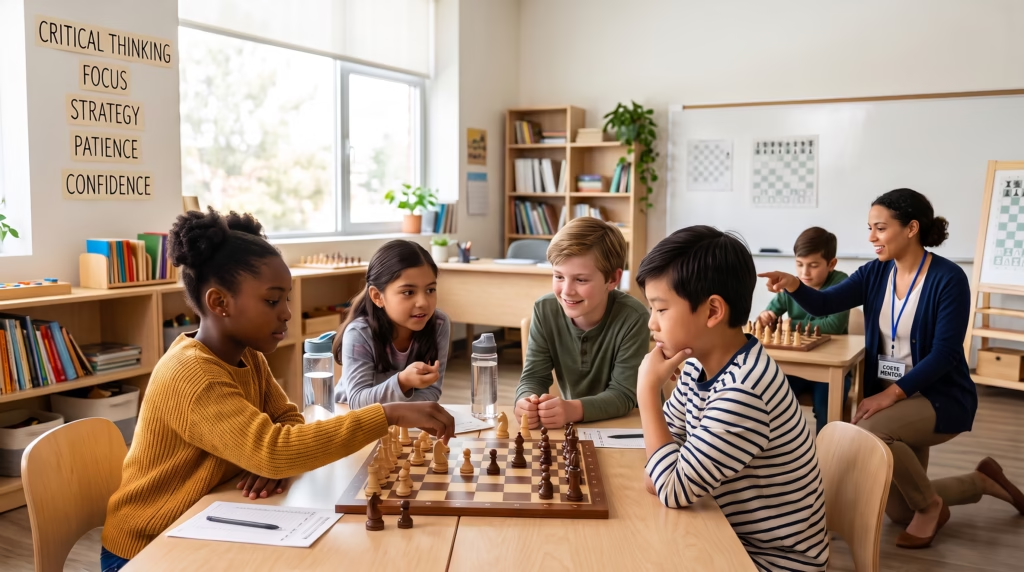
What are the benefits of chess for kids? A chess lesson gives children opportunities to study a position, compare choices, explain their reasoning and learn from mistakes. These are meaningful activities within the game. They do not mean that chess automatically raises intelligence, improves grades or changes a child’s behavior outside lessons.
For parents, a useful question is: what will my child actually practice at the board? Here are seven examples, followed by what research can and cannot tell us.
1. Looking carefully before acting
A beginner may notice an opponent’s queen but overlook a bishop attacking from the other side of the board. Before choosing a move, the child needs to check what changed and which pieces are under attack.
A simple practice routine is to ask: “What did the last move threaten? Is my king safe? Is the piece I want to move protected?” Start with one question rather than a long checklist.
This gives attention a specific task. Progress might mean spotting an undefended piece without a reminder, rather than simply sitting still for longer.
2. Comparing possible solutions
When a piece is attacked, moving it is not always the only answer. A child might defend it, exchange the attacking piece or create a stronger threat elsewhere.
Ask the child to suggest two possible moves and explain a reason for each. Then look for the opponent’s strongest reply. The aim is to practice checking an idea rather than guessing what the teacher wants to hear.
Keep the position manageable. A board with a few pieces can provide a useful problem without overwhelming a new player.
3. Planning ahead and adapting
Chess offers clear examples of short-term planning. To promote a pawn, a child may need to bring the king closer, protect the pawn and work out whether the opposing king can stop it.
A useful teaching prompt is: “What are you trying to achieve, and what could stop your plan?” After the opponent moves, revisit that question.
Planning in chess includes changing direction when the position changes. A good lesson allows children to revise an idea instead of treating their first plan as a promise they must keep.
4. Recognizing patterns and recalling ideas
A knight fork attacks two targets at once. After learning this pattern, a child can look for it in different positions rather than memorize a single arrangement of pieces.
Try showing two examples and asking what they have in common. Later, return to the idea with the pieces on different squares. Ask the child to explain how the fork works and whether the knight can be captured.
This is purposeful practice in recognizing and remembering chess ideas. It should not be presented as proof that chess improves memory for unrelated school subjects.
5. Explaining decisions clearly
“What made you choose that move?” can be more useful than immediately saying whether a move was good or bad.
A child might explain that a rook belongs on an open file, a king needs protection or a trade would remove an important defender. A teacher can then ask a short follow-up question and help the child check the explanation against the board.
The goal is understandable reasoning, not advanced vocabulary. Giving children time to explain also helps the instructor see which ideas need another example.
6. Reviewing mistakes constructively
Losing a piece or a game can be disappointing. A calm review gives the child something specific to work on: perhaps checking for threats before capturing, or recognizing when the king is in danger.
Choose one useful moment rather than criticizing every move. Ask: “What did you notice during the game? What do you see now? What could you check next time?”
Adults can model the same approach when they make mistakes. Avoid labeling a child careless or judging ability from a single result. Improvement is easier to discuss when the focus stays on a decision that can be examined.
7. Practicing patience and respectful competition
A game creates opportunities to wait for a turn, follow shared rules and treat an opponent respectfully. Children can also practice pausing before a move instead of immediately touching the first attractive piece.
These behaviors need guidance. Playing chess does not automatically make a child patient, and frustration should not be treated as a failure of character.
For home practice, agree on a few simple expectations: let the other player think, ask politely about a rule, and take a break when needed. Keep the emphasis on an enjoyable game and respectful behavior, not winning at any cost.
What does research say about chess and school performance?
Research on benefits beyond chess is mixed, and study design matters. A 2016 meta-analysis found positive average results across studies of academic and cognitive outcomes, but the researchers identified important weaknesses in the evidence. In particular, the studies did not adequately separate the effects of chess from attention, enthusiasm or taking part in a new activity. Read Sala and Gobet’s meta-analysis.
A large English trial involving 100 schools and 4,009 pupils found no improvement in mathematics, reading or science attainment one year after the chess intervention ended. Many pupils nevertheless enjoyed the lessons. Read the Education Endowment Foundation evaluation.
Two further experiments compared chess with other games and regular school activities. They did not establish an advantage for chess in the mathematical problem-solving and metacognitive outcomes tested. Read the 2017 experimental studies.
These findings do not make chess an unworthy hobby. They do mean that parents should be cautious about promises of higher IQ, better grades or broad improvements in concentration. The seven activities above describe practice opportunities at the board, not seven scientifically proven changes in general ability. Choose chess for the game, the learning experience and your child’s interest; keep ordinary academic support in place.
How parents can make chess practice worthwhile
- Match the task to the child. Begin with piece moves or a small position before expecting a complete game.
- Keep practice manageable. A short, enjoyable session is preferable to continuing when the child is tired or upset.
- Ask for an explanation. Give the child time to think before offering a hint.
- Notice specific progress. Recognizing a threat or explaining a plan matters even when the game is lost.
- Listen to the child. Interest, enjoyment and willingness to return are useful signs when deciding whether to continue.
Explore chess lessons for your child
If your child would benefit from structured instruction, explore private chess coaching in Houston or private online chess lessons and discuss their experience and goals with us. The priority is to help them understand and enjoy chess, with lessons suited to their current level.