By GM Ulvi Bajarani, Founder and Head Coach of Azeri Chess Academy.
Finding the first move of a chess puzzle is only part of the task. Can you explain why it works, anticipate the opponent’s strongest reply, and evaluate the position at the end of your line?
Those questions make puzzle practice useful beyond the solving screen. A correct move found by guessing gives you different information from a correct move supported by a complete calculation. Both may appear as a success in an app, but only your own review can show what you understood.
This guide offers a practical solving method for players who know the rules and want to use puzzles more purposefully. It includes three short exercises, explanations of tempting mistakes, and a record you can use in your next training session.
#1 — Decide what you are training
Puzzle practice can serve several purposes. Familiar, short positions can help you recognize patterns. More demanding positions can train calculation and the ability to keep an imagined position accurate. Timed solving adds pressure and rewards quick recognition.
Choose the purpose before beginning. If today’s goal is careful calculation, rushing to protect a streak works against it. If the goal is a short speed drill, do not judge that session by the same standard as an untimed exercise in which you write down variations.
There is room for both kinds of practice. The important distinction is whether you are deliberately training a skill or simply trying to make a number increase.
For the method below, use an untimed session. Keep the starting position visible, but do not move pieces while deciding on your answer. If that is currently too difficult, work with shorter lines first. Our visualization guide explains how to track changes one move at a time.
#2 — Read the position before choosing a move
Before searching for a combination, establish what is actually on the board:
- Whose turn is it, and is that side in check?
- What is the material balance?
- Which pieces are attacked or undefended?
- What threats already exist?
- Which files, ranks and diagonals are open or could become open?
- Are the kings short of safe squares?
Notice the opponent’s last move when it is supplied. It may have moved a defender, opened a line or created a threat. Also examine pieces far from the apparent action. A rook on the opposite side of the board may be able to capture your attacking piece.
Read the task as carefully as the position. Some exercises ask for mate or material gain; others ask you to defend, draw or evaluate an idea. Do not force a winning combination into a position simply because it appears in a training exercise.
#3 — Calculate candidates against the best defense
Generate a small set of plausible moves by examining candidates in this order:
- Checks
- Captures
- Moves creating threats (threatening moves)
- Other moves
This is an order for searching, not a rule that the best move must belong to the first available category. A check may fail, a capture may lose material, and a quiet move may be the strongest choice. Use the sequence to organize your search, then calculate and compare the candidates rather than automatically choosing the first forcing move you find.
For each candidate, switch sides mentally. What would you play if you were defending?
If your move gives check, consider whether the opponent can capture the checking piece, block the line, or move the king. If it does not give check, look for the opponent’s own forcing moves. A threat against their queen may fail if they can mate you first.
Do not assume that an attacked piece must move or that a sacrificed piece must be captured. Calculate the reply that challenges your idea most strongly, not the reply that makes your solution look attractive.
Keep separate variations separate. After finishing one branch, return to the starting position before examining another. A capture in one variation must not remove a piece from a different variation in your imagination.
FM Nate Solon’s puzzle-training article similarly emphasizes examining the opponent’s defensive resources before committing to the first move. That is a useful discipline whether you solve online, from a book or over a physical board.
#4 — Know when to stop and evaluate
“Calculate the full solution” does not mean predict the rest of the game. Calculate far enough to justify the claim you are making.
If the task is mate in two, you must account for the opponent’s legal defenses and show the final mate. If the idea wins a piece, continue through relevant recaptures and checks. Stopping immediately after taking a queen is unsafe if your own king is about to be mated.
At the endpoint, ask:
- What material remains after the exchanges?
- Is either king in danger?
- Is an apparently won piece about to be lost again?
- Does the position actually meet the task?
Then make one final check of your first move. Is it legal? Did you overlook a pin, an intermediate check or a defender?
Write your answer before revealing the solution. A short line and a sentence explaining the idea are enough. This preserves the difference between what you found independently and what became obvious afterward.
#5 — Try three exercises
All diagrams are shown with White at the bottom. White are to move. These are teaching examples, not scores attributed to named players. The first two are simplified constructed positions; the third is reached by the legal opening sequence given below.
Try to answer before reading the next section.
Exercise A: Account for every escape
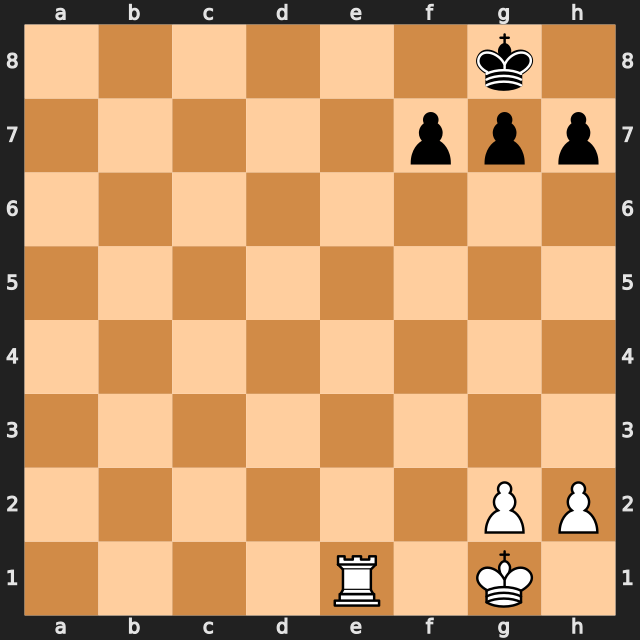
Find mate in one. Explain why the king cannot escape, rather than merely naming the move.
Exercise B: One additional defender
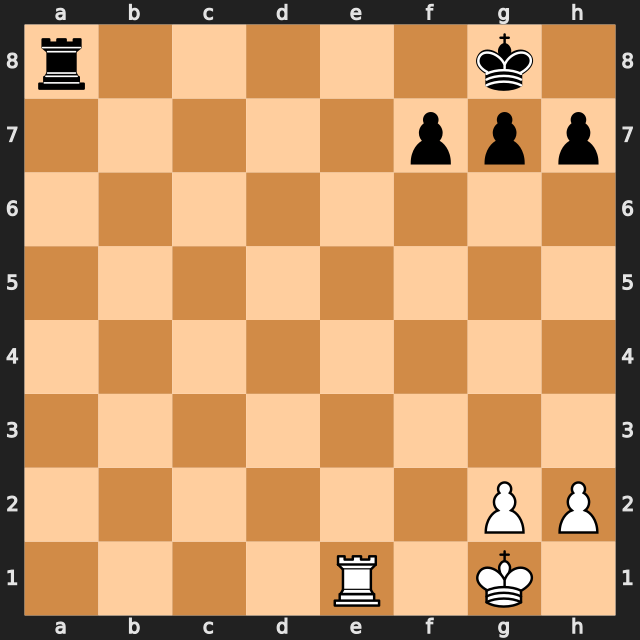
Now Black also have a rook on a8. Does the same checking move work? Give Black’s reply. This is an exercise in testing an idea, not an instruction to find a forced win.
Exercise C: Look beyond the captured queen
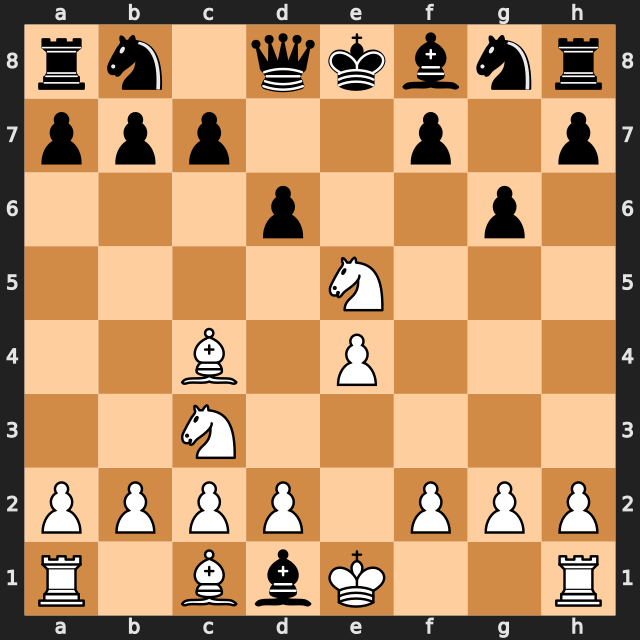
The position follows:
1. e4 e5 2. Nf3 d6 3. Bc4 Bg4 4. Nc3 g6 5. Nxe5 Bxd1
Black have captured White’s queen. White can nevertheless force mate in two moves. Find the first move, Black’s reply and the finish.
This exercise uses a familiar mating pattern associated with Légal’s trap. It is not a recommendation to play the opening sequence, a claim that Black had to take the queen, or an attribution to a historical game.
#6 — Check the answers and the alternatives
Exercise A: 1. Re8#
The rook checks along the eighth rank. It controls f8 and h8, while Black’s own pawns occupy f7, g7 and h7. Black cannot capture the rook or interpose a piece. Every possible response to the check is unavailable.
The key is the combination of the rook’s open line and the king’s restricted escape squares. Merely noticing that the rook can reach the last rank is not enough.
Exercise B: 1. Re8+? Rxe8
The additional rook changes the answer. Black’s rook can travel from a8 to e8 and capture the checking rook. The squares between them are empty.
A familiar pattern gave White a candidate move. Examining the whole board refuted it. In this position, 1…Rxe8 is Black’s only legal answer to the check, and it removes White’s rook.
When you revisit a familiar puzzle, ask what makes its solution work. Memorizing “rook to the back rank” without noticing defenders can lead to the wrong decision in a similar position.
Exercise C: 6. Bxf7+! Ke7 7. Nd5#
The bishop captures on f7 with check. Black cannot play 6…Kxf7 because White’s knight on e5 protects f7. The same knight controls d7; Black’s queen and bishop occupy d8 and f8. Black cannot block this adjacent diagonal check. The only legal reply is 6…Ke7.
White then play 7.Nd5#, moving the knight from c3. The knight checks the king on e7. White’s other pieces cover the relevant escape squares, and Black’s own pieces occupy others. Because the checking piece is a knight, interposing a piece cannot stop the check.
A tempting alternative is 7.Nxg6+, moving the knight from e5 and capturing a pawn. It is a legal check, but it is not mate: Black can answer 7…hxg6, capturing that knight. Finding a check does not finish the calculation.
The exercise also shows why material must be evaluated at an appropriate endpoint. Stopping after 5…Bxd1 gives an incomplete picture. The forcing continuation changes the result immediately.
#7 — Review mistakes and choose suitable difficulty
When an answer is wrong, identify the first point where your reasoning broke down:
- You did not consider the right candidate.
- You saw the candidate but missed a defensive reply.
- You lost track of a piece or an opened line.
- You stopped before a recapture or intermediate move.
- You calculated the line but evaluated its final position incorrectly.
- You moved before completing the work you intended to do.
Those are different training needs. Repeating harder puzzles may not address a basic visualization error. Slowing down may help a rushed answer, but not teach a tactical pattern you have never encountered.
If a tactical pattern is unfamiliar, study our guide to chess tactics with examples before returning to similar puzzles.
After reviewing the solution, explain it in your own words. Later, revisit the position without the answer visible. Do not count immediate repetition from memory as proof that the problem is solved permanently.
Choose difficulty that lets you do meaningful work. If you routinely cannot generate a candidate, use simpler examples or study the relevant motif first. If every answer is immediate and obvious, add some positions requiring a defensive reply or an additional branch. A mixture can be useful; no single success percentage is a universal requirement.
#8 — Build a routine you can sustain
A short session can include three parts:
- Solve a small set carefully.
- Review errors and uncertain answers.
- Revisit one earlier difficulty.
Adjust the number of positions to their complexity. Five demanding exercises may take longer than twenty familiar patterns. Finishing a quota is less informative than understanding what went wrong.
Use a simple record:
- Position or source:
- My candidate and calculated line:
- Defense I overlooked:
- What changed in the final position:
- One point to remember:
- Date to revisit:
This can be kept in a notebook or alongside your PGN material. Our notation guide explains how to record moves and positions.
Puzzle rating can provide feedback within a platform, but it should not be treated as a direct prediction of game rating. Different tasks, playing conditions and rating systems matter. Chess.com also changed its puzzle-rating system in October 2025, so old numerical comparisons may no longer describe its current system. Avoid converting your puzzle rating into a supposed playing rating by subtracting a fixed number.
#9 — Carry the habits into your games
During a game, nobody announces that the position contains a tactic. You must notice when calculation is needed and when a quiet improving move is more appropriate.
After a game, find a position where a forcing opportunity or defensive resource was missed. Examine it before turning on the engine, then compare your analysis with the actual possibilities. Our game-review guide provides a framework.
Look for changes in your decisions, not only in your puzzle score. Are you checking the opponent’s replies more consistently? Are you overlooking fewer recaptures? Can you explain why an attractive move fails?
These observations can help you choose your next assignment or discuss a specific difficulty with a coach. Puzzle practice becomes more useful when it is connected to the mistakes and decisions in your own games.
If you would like help reviewing those decisions, explore our private online chess lessons or in-person coaching in Houston.
#10 — Sources and further reading
- FM Nate Solon: The Right Way to Improve Your Tactics Using Puzzles, on consistent practice, reviewing mistakes and defensive resources.
- Chess.com: New Puzzles Ratings, Difficulty Settings, and More Consistent Experience, October 9, 2025.
- Chess.com: How Do Puzzle Ratings Work?, current platform guidance checked November 12, 2026.
- Lichess: Chess Rating Systems, explaining why ratings from different pools are not directly interchangeable.
- Azeri Chess Academy: Chess Visualization Exercises.
- Azeri Chess Academy: Chess Study Plan.
The exercises and commentary were prepared for this guide. The short mating lines and stated legal replies were checked by exhaustive legal-move analysis. They are elementary teaching examples, not engine evaluations of the entire opening or composed-position winning chances.
Diagram credits
Chess-piece artwork © Colin M. L. Burnett (Cburnett), rendered using python-chess under the BSD licensing option. Pieces were arranged on labeled boards for these exercises. The artwork is also documented on Wikimedia Commons.
Chess-piece artwork license notice
Copyright © The author (Colin M. L. Burnett).
Redistribution and use in source and binary forms, with or without modification, are permitted provided that the following conditions are met:
- Redistributions of source code must retain the above copyright notice, this list of conditions and the following disclaimer.
- Redistributions in binary form must reproduce the above copyright notice, this list of conditions and the following disclaimer in the documentation and/or other materials provided with the distribution.
- Neither the name of The author nor the names of its contributors may be used to endorse or promote products derived from this software without specific prior written permission.
This software is provided by The author and contributors “as is” and any express or implied warranties, including, but not limited to, the implied warranties of merchantability and fitness for a particular purpose are disclaimed.
In no event shall The author and contributors be liable for any direct, indirect, incidental, special, exemplary, or consequential damages (including, but not limited to, procurement of substitute goods or services; loss of use, data, or profits; or business interruption) however caused and on any theory of liability, whether in contract, strict liability, or tort (including negligence or otherwise) arising in any way out of the use of this software, even if advised of the possibility of such damage.