
By GM Ulvi Bajarani, Founder and Head Coach of Azeri Chess Academy.
A useful chess record lets you return to a game, find the moment when your plan changed, and discuss the position with a coach. Learning to write the moves also makes chess books and annotated games easier to follow.
Start with algebraic notation for moves. Use PGN to save a game or a line of analysis, FEN to transfer one position into chess software, and a diagram or ASCII board to show where the pieces stand. These formats work together, but they preserve different information.
This guide explains each method through practical examples. The main example appears as a scoresheet, a PGN record, a diagram, an ASCII board and a FEN string, so you can compare them directly.
Choose the right format
| Format | What it records | When to use it |
|---|---|---|
| Algebraic notation | Individual moves in a position | Reading a book or keeping a scoresheet |
| PGN | Moves, game details and optional annotations | Saving, replaying and sharing games |
| Diagram | A visual arrangement of pieces | Lessons, articles and exercises |
| ASCII board | An arrangement drawn with plain text characters | Text messages, notes and technical discussions |
| FEN | Piece placement and five additional state fields | Loading a position into a board editor or analysis tool |
Learn the names of the squares
Every square has a fixed address. The files are the columns a through h, and the ranks are the rows 1 through 8. Write the file first and the rank second: a1, e4, h8.
From White's side, a1 is the bottom-left square and h1 is the bottom-right square. The a1 square is dark; h1 is light. White's pieces begin on ranks 1 and 2, and Black's pieces begin on ranks 8 and 7. Turning the board around does not change the square names.
Find a few squares before reading a game: e4, c6, f3 and b5. Then say each move's destination aloud while playing through the example below. The coordinates around a diagram are there to help you, even when the board is shown from Black's side.
Write moves in algebraic notation
In English notation, use K for king, Q for queen, R for rook, B for bishop and N for knight. The knight uses N because K already identifies the king. A pawn move has no initial piece letter: write e4, not Pe4.
Printed chess books sometimes replace piece letters with small symbols called figurines. For example,  f3 means Nf3, and
 xc6 means Bxc6. This is figurine algebraic notation. Keep the English letters when preparing a standard PGN file.
Diagram symbols for White: 


 . For Black:





 .
For an ordinary move, combine the piece letter and destination square. Nf3 means that a knight moves to f3. Bb5 means that a bishop moves to b5. The position tells you which piece can make the move.
The following forms are standard algebraic notation, or SAN, as used in PGN. The examples describe notation patterns, not a single sequence of moves.
| Form | Meaning |
|---|---|
| e4 | A pawn moves to e4 |
| Nf3 | A knight moves to f3 |
| Bxc6 | A bishop captures on c6 |
| dxc6 | A pawn from the d-file captures on c6 |
| Bb5+ | A bishop moves to b5 and gives check |
| Qxf7# | A queen captures on f7 and gives checkmate |
| O-O | Kingside castling |
| O-O-O | Queenside castling |
| e8=Q+ | A pawn promotes to a queen on e8 and gives check |
A capture names the destination square, not the captured piece. In Bxc6, the notation does not tell you whether the bishop captured a knight, rook or another piece. Read that from the position. For a pawn capture, the starting file is essential: dxc6 means that the capturing pawn came from the d-file.
Identify the correct piece
When more than one piece of the same kind can legally reach the destination, add enough information to identify the one that moves. If knights on b1 and f3 can both legally move to d2, write Nbd2 or Nfd2. If rooks on a1 and a3 can both legally move to a2, write R1a2 or R3a2.
In SAN, use the starting file if it is sufficient; otherwise use the starting rank. In rare positions, both are necessary. Only legal moves count: a pinned piece that cannot legally reach the square does not create ambiguity. The symbols x and + do not replace the information identifying the moving piece.
Record special moves and results
Castling is written as one move, not as separate king and rook moves. Promotion must name the new piece; it need not be a queen. In SAN, e8=N means promotion to a knight. Add + or # when the promotion gives check or checkmate.
An en passant capture is written like another pawn capture. After 1. e4 c6 2. e5 d5, White can play 3. exd6: the pawn goes from e5 to d6, while the black pawn on d5 is removed. In a PGN move token, exd6 is sufficient; an explanation can go in a comment.
The usual results are 1-0 for a White win, 0-1 for a Black win and 1/2-1/2 for a draw. A PGN record uses * when the game is unfinished or its result is unavailable. Checkmate notation and the game result are separate: a move can end with #, followed by the result.
Distinguish scoresheet notation from PGN
FIDE's Appendix C and PGN SAN are closely related, but their written conventions are not identical. Appendix C shows 0-0 and 0-0-0 with zeros and promotion such as e8Q. PGN SAN uses capital letter O in O-O and O-O-O, and an equals sign in e8=Q. Appendix C also permits omission of capture and check indicators and allows ++ or # for mate. For a clean PGN export, include the required SAN indicators and use # for mate. The examples in this guide retain x, + and # for clarity. FIDE Appendix C and PGN specification, section 8.2.3
Keep a clear scoresheet
A scoresheet normally has one row for each move number, with a column for White and another for Black. One numbered row can therefore contain two moves, one by each player. The number 5 refers to the fifth pair; 5…Bd6 identifies Black's fifth move.
Before play, fill in the event, date, round, players' names and any other details requested on the scoresheet, such as the board number, section and time control. This information makes the game easier to identify later.
Here is a short opening example, ending after Black's fifth move. It is a teaching line, not a completed game.
| Move | White | Black |
|---|---|---|
| 1 | e4 | e5 |
| 2 | Nf3 | Nc6 |
| 3 | Bb5 | a6 |
| 4 | Bxc6 | dxc6 |
| 5 | 0-0 | Bd6 |
White's bishop captures the knight on c6, and Black's d-pawn recaptures. White then castle kingside. The king reaches g1 and the rook from h1 reaches f1. Black develop the bishop to d6. White are to move on move 6.
Under FIDE's ordinary recording rules, record both players' moves legibly and do not write a proposed move in advance, apart from the specified draw-claim and adjournment exceptions. Mark a draw offer with (=). At the end, check the result before signing both scoresheets. The under-five-minute exemption applies only when the increment is less than 30 seconds per move; rapid and blitz have separate provisions. Ask the arbiter which requirements apply to your event. FIDE Laws, Article 8 and Appendices A and B
Develop a steady habit during practice: play your move, press the clock when using one, and record the move. Record your opponent's reply clearly too. After the game, replay the score from the starting position. If a move cannot be reconstructed, investigate it while the game is still fresh rather than silently guessing.
Save the game as PGN
PGN stands for Portable Game Notation. It combines information about a game with its moves. SAN supplies the move notation inside the PGN record; PGN is the larger file format. A plain move list may be importable, but a well-kept game record should also identify the players, event and result.
Here is the same teaching line as a PGN record. The question marks are deliberate placeholders, not missing information about an actual tournament.
[Event "Notation teaching example"]
[Site "?"]
[Date "????.??.??"]
[Round "?"]
[White "White"]
[Black "Black"]
[Result "*"]

1. e4 e5 2. Nf3 Nc6 3. Bb5 a6 4. Bxc6 dxc6 5. O-O Bd6 *
The final * agrees with the Result tag. Notice the capital O in O-O. Save this text with a .pgn extension or paste it into a tool's PGN import field. Replay it once after importing.
PGN can also preserve comments in braces and alternative lines in parentheses. Add analysis after the game, not as notes on a live tournament scoresheet. If a PGN starts from a position other than the usual initial setup, use a SetUp tag with value "1" and a FEN tag containing the starting position. PGN specification, sections 8 and 9.7
Show a position with a diagram
A diagram makes the placement of the pieces easy to see. The position below is the one reached after 5…Bd6 in our example. It is shown from White's side: rank 8 is at the top and file a is on the left.
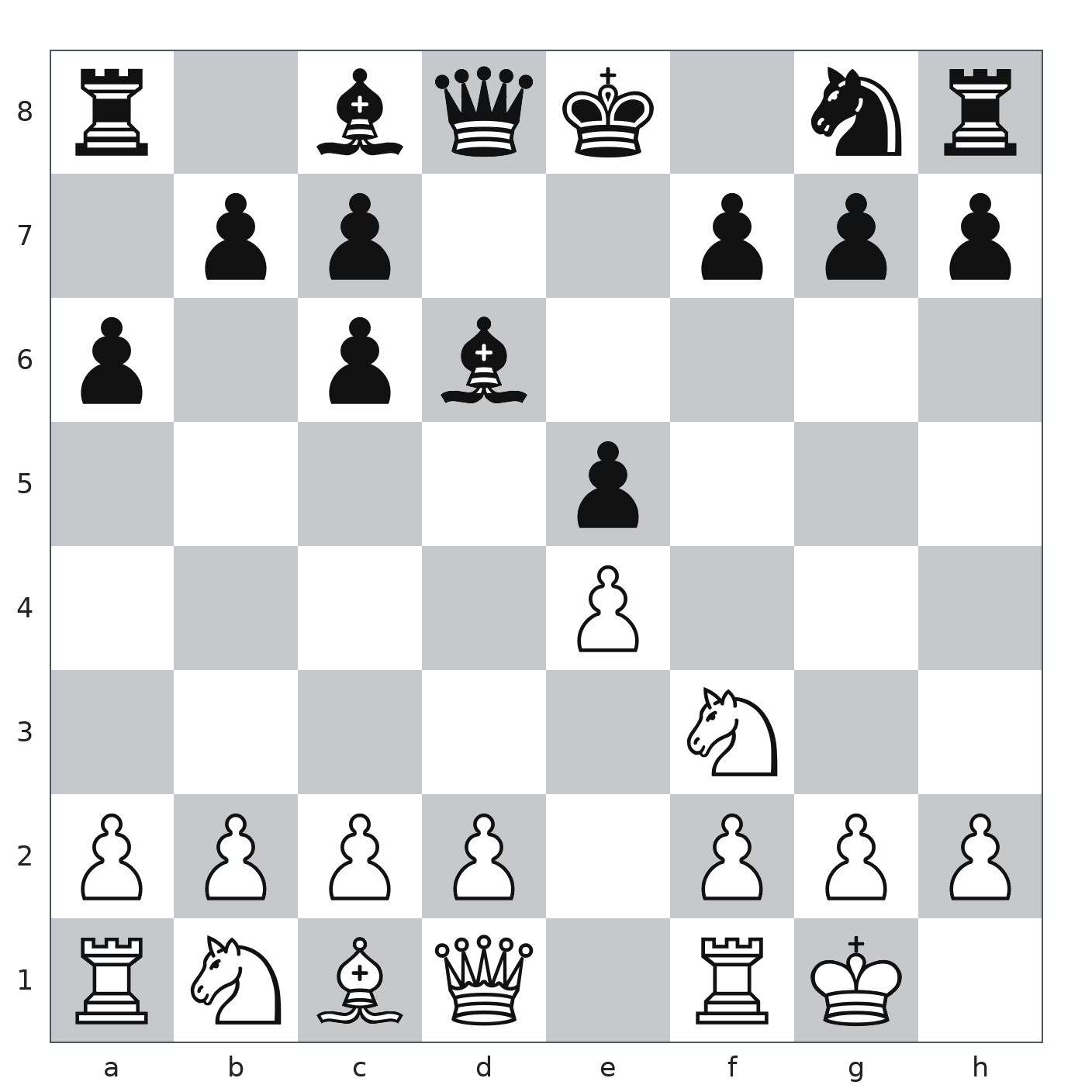
A diagram alone does not reliably preserve all the information needed to continue a game. Two identical arrangements can have different sides to move or different castling rights. Always label whose turn it is, and supply a FEN when you want someone to load the exact recorded state.
For an article or exercise, use a clear board with coordinates and a readable caption. If you rotate the board, keep its coordinate labels correct. Check every piece against the source game before sharing it.
Record a position as a piece list
You can also describe a position by listing the pieces and their squares separately for each side. The Saint Louis Chess Club booklet uses this approach in its setup exercises. Here is an original example using Figure 1. Learn to Read & Write Chess, printed page 3
- White: Kg1, Qd1, Ra1, Rf1, Bc1, Nb1, Nf3. Pawns: a2, b2, c2, d2, e4, f2, g2, h2.
- Black: Ke8, Qd8, Ra8, Rh8, Bc8, Bd6, Ng8. Pawns: a6, b7, c7, c6, e5, f7, g7, h7.
These entries describe where the pieces stand; they are not a sequence of moves. Include the side to move and any relevant castling or en passant information, just as you would with a diagram. Ask a partner to reconstruct the position from the list, then compare the boards square by square.
Draw the same board in ASCII
ASCII uses ordinary text characters. An ASCII chess board is useful when you cannot send an image, but there is no single universal ASCII board layout. State the convention rather than assuming the reader will recognize it.
In this board, uppercase letters represent White's pieces, lowercase letters represent Black's pieces, and a period is an empty square. P and p represent pawns. The ranks run downward from 8 to 1; each row has exactly eight square entries.
8  r . b q k . n r
7  . p p . . p p p
6  p . p b . . . .
5  . . . . p . . .
4  . . . . P . . .
3  . . . . . N . .
2  P P P P . P P P
1  R N B Q . R K .
   a b c d e f g h
This is Figure 1 again: White to move, Black retain both castling rights, White retain none, and there is no en passant target.
Use a monospaced font so the columns stay aligned. Do not replace runs of spaces with tabs when copying between programs. Symbols such as and are Unicode chess characters, not ASCII; they can be helpful visually, but their appearance depends on the font. For reliable software import, send FEN rather than expecting a program to interpret your text drawing.
Record the position with FEN
FEN stands for Forsyth–Edwards Notation. It describes one position in a single line. A standard FEN has six fields separated by spaces, not just a description of the pieces.
Our example position has this FEN:
r1bqk1nr/1pp2ppp/p1pb4/4p3/4P3/5N2/PPPP1PPP/RNBQ1RK1 w kq - 2 6| Field | Example | Meaning |
|---|---|---|
| 1 | r1bqk1nr/…/RNBQ1RK1 | Piece placement, from rank 8 to rank 1 |
| 2 | w | White to move; b would mean Black |
| 3 | kq | Black retain kingside and queenside castling rights |
| 4 | – | No en passant target square |
| 5 | 2 | Two halfmoves since the last pawn move or capture |
| 6 | 6 | The current fullmove number is 6 |
The shortened placement in the table is only a label. Copy the complete FEN line above when importing the position.
Read the piece placement
Read the first field from a8 to h8, then a7 to h7, continuing down to a1 through h1. A slash ends a rank. Uppercase KQRBNP are White's pieces, and lowercase kqrbnp are Black's. A digit counts consecutive empty squares. Each rank must expand to exactly eight squares.
The first rank description in our FEN, r1bqk1nr, means a black rook on a8, one empty square on b8, then a bishop on c8, queen on d8, king on e8, one empty square on f8, knight on g8 and rook on h8. The entry 4p3 means four empty squares, a black pawn on the fifth square of that rank, then three empty squares. An empty rank is written 8.
Preserve the state beyond the pieces
The castling field uses K and Q for White's kingside and queenside rights, and k and q for Black's. Use – if neither side retains any. These are retained rights, not a claim that castling is legal immediately: intervening pieces or attacked squares may still prevent it. A king or rook that moved and returned does not regain the corresponding right.
A halfmove is one player's move. In our example, 4…dxc6 resets the halfmove clock to zero. Then 5.O-O raises it to 1, and 5…Bd6 raises it to 2. Castling does not reset this counter. The fullmove number begins at 1 and increases after each move by Black, so after Black's fifth move it becomes 6. The halfmove clock concerns move-count draw rules, not elapsed minutes on a chess clock. python-chess documentation on board state and FEN
Understand the en passant field
The en passant target is the square crossed by a pawn's immediately preceding two-square advance. In the original FEN specification, this square is recorded even if no opposing pawn can capture there. After 1.e4, the original-form FEN is:
rnbqkbnr/pppppppp/8/8/4P3/8/PPPP1PPP/RNBQKBNR b KQkq e3 0 1Black have no en passant capture in this position, but the original convention still records e3. Some software instead writes – unless a legal en passant capture exists. For example, python-chess defaults to legal captures only and provides a separate option for original FEN behavior. A difference in this field can therefore reflect export conventions rather than different piece placement. FEN specification, section 16.1 and python-chess FEN export options
For a position where the capture really is available, use our earlier line, 1. e4 c6 2. e5 d5:
rnbqkbnr/pp2pppp/2p5/3pP3/8/8/PPPP1PPP/RNBQKBNR w KQkq d6 0 3White can now play 3.exd6 en passant. The target is d6, not the black pawn's square d5. The right lasts only for this immediate reply; it does not remain available after a different move.
Know what FEN leaves out
FEN does not store the earlier moves, the players' names, the clock times or your annotations. It also does not preserve the position history needed to establish repetition. Save the PGN when the route to the position matters.
If all you have is a picture, do not invent castling rights, an en passant target or historical counters. For a study setup, choose and state the intended assumptions. For a game record, recover them from the moves whenever possible. A FEN that loads successfully can still contain wrong historical information.
Build a reliable recording habit
Practice with the example in this article before recording a long game:
- Play the ten individual moves on a board, reading each move aloud.
- Check the final arrangement against Figure 1 and the ASCII board.
- Import the PGN and confirm that it reaches the same position.
- Import the FEN separately and check whose turn it is and the castling rights.
- Record a short practice game of your own, then replay it without relying on memory.
Before sharing a game, check move numbers, captures, promotions and the result. Before sharing a position, check all 64 squares, the board orientation and the side to move. Include the FEN whenever the recipient needs to recreate the position accurately.
Good notation makes your games useful after the pieces have been put away. Begin by writing a few moves correctly, then make recording and replaying your own games part of your regular training.
Would you like help reviewing your own games? Explore our private online chess lessons or in-person chess coaching in Houston.
Further reading
- Learn to Read & Write Chess by Jeanne Cairns Sinquefield. The complete booklet, ©2018, version 10, published by the World Chess Hall of Fame. It combines piece and square identification, position setup, spoken and written moves, practice games, scoresheets and activities for coaches.
- FIDE Laws of Chess. Appendix C explains algebraic notation; Article 8 covers recording moves. Check the applicable event regulations as well.
- Portable Game Notation Specification and Implementation Guide. HTML reproduction of the original specification coordinated by Steven J. Edwards. See section 8.2.3 for SAN, section 9.7 for starting positions and section 16.1 for FEN.
- python-chess documentation. A technical reference for legal moves, position state and FEN export conventions.
Related articles from Azeri Chess Academy: