By GM Ulvi Bajarani, Founder and Head Coach of Azeri Chess Academy.
A practical skills check for introductory chess learning
“Am I a beginner, intermediate or advanced learner?” The answer should help you choose your next lesson. You may still be learning how the pieces move, or you may already be using basic tactics and plans. Start with what you can explain and demonstrate, rather than a rating or a total puzzle score.
Here, beginner, intermediate and advanced describe stages within introductory chess learning. An advanced learner in this article is not an advanced competitive player. Begin with the rules check below, then try the six positions when their instructions make sense. These are informal teaching guides, not official course levels or a standardized placement test.
Start with the board and rules
On a board, try the checks below. For each one, say “I can show this,” “I need help” or “I have not learned this.” A teacher or partner can confirm the moves; you do not need to teach yourself missing rules to finish this assessment.
- Set up the board and pieces, including a light square at the near right corner.
- Show how each piece moves and captures. Include a pawn’s forward move and diagonal capture, and a knight’s jump.
- Show what check means, why a king cannot move into check, and how a player can answer a check.
- Explain the difference between checkmate and stalemate using a small position.
- Show or explain castling, pawn promotion and en passant, including when each is legal.
If any check is unfamiliar, begin with that topic. Uncertainty about a special move does not prevent trying a diagram that does not use it. Before a diagram, make sure you know how its pieces move and what the question asks. If “threat,” “forcing move,” “exchange” or “development” is new to you, ask for an explanation and treat that task as learning rather than independent assessment.
Use the positions as a starting point
Try only the positions whose rules and instructions you understand, before reading the answers. Write your move or conclusion, the reply you expect, and a short explanation. If notation is unfamiliar, point out the moves on a board. Notation is not a prerequisite for this check.
Work without an engine or hints on the first attempt. There is no pass-or-fail time limit. Record whether you explained the answer independently, understood part of it, needed help, or have not learned the topic yet. Mark a familiar example as familiar rather than treating recall as a new solution.
An adult or coach may read the instructions and explain unfamiliar words without suggesting a move. If explaining the task requires teaching a new rule or concept, use it as a lesson and mark it “not yet learned.” You do not need to attempt all six positions. They are not a strict ladder of difficulty.
In the answers, K means king, Q queen, R rook, B bishop and N knight. The symbol x means capture, + means check, and # means checkmate. In every diagram, a1 is the dark square at the bottom left.
Look for a pattern rather than a total score
Look for what you understand and what still needs teaching. A task you have not learned is not a failed test. Do not turn the six observations into a rating or a numerical level cutoff. The learning descriptions after the answers help you choose a starting point.
#1 — Check the rules
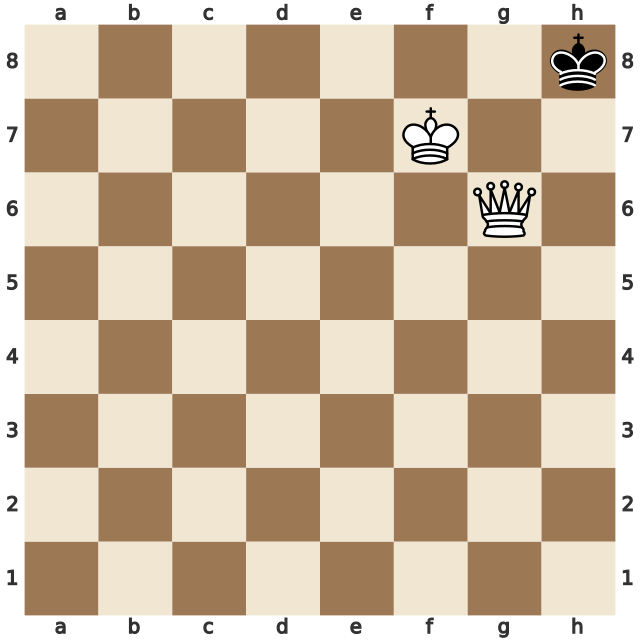
Black to move. Is this checkmate, stalemate or a position in which play continues? Explain what each possible king move would run into.
Your answer and reason: __________________________________________________
#2 — Notice the threat
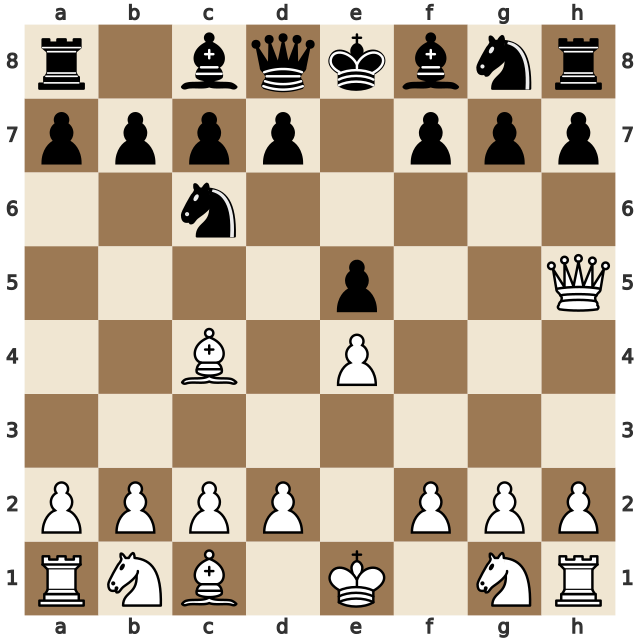
Black to move. What is White threatening? Would 3…Nf6 solve the problem? Find a move that addresses the immediate threat and explain how it works.
Your answer and reason: __________________________________________________
#3 — Calculate a forcing sequence
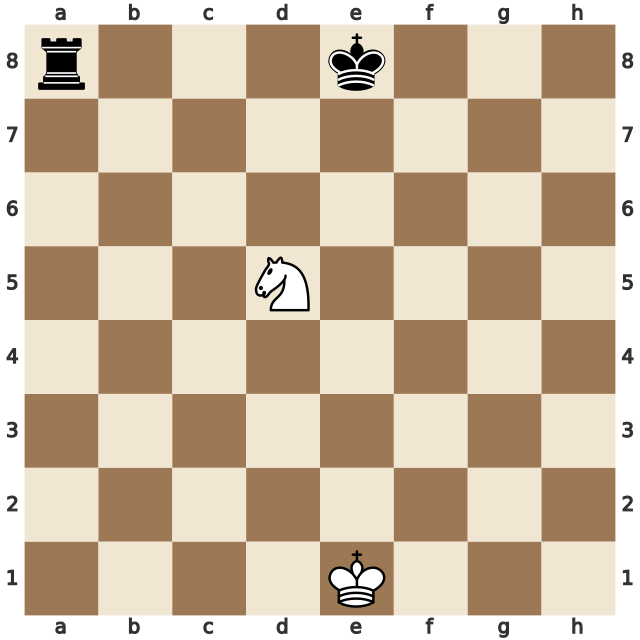
White to move. Find a forcing move that wins the rook. Write a legal reply for Black and White’s follow-up. Explain why Black cannot simply save the rook immediately.
Your answer and reason: __________________________________________________
#4 — Finish the exchange
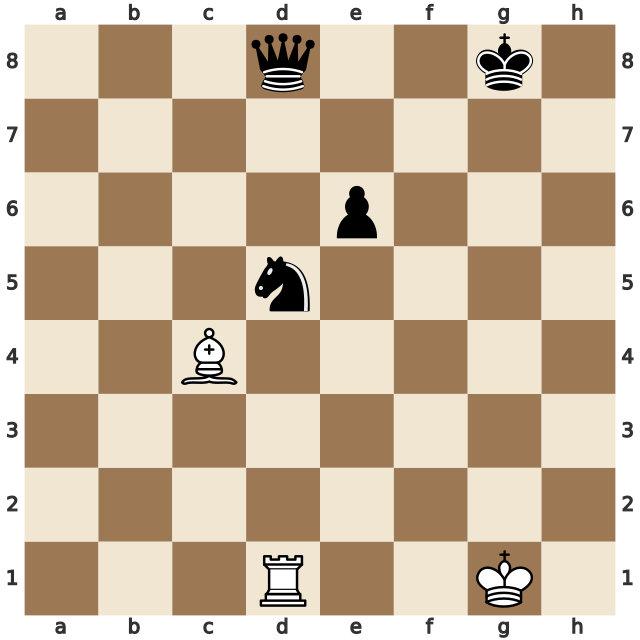
White to move. Consider this proposed exchange: 1.Bxd5 exd5 2.Rxd5. Does White win a pawn? Continue the line by one Black move before drawing a conclusion. This is a calculation question about the given sequence, not a request for the best move in the starting position.
Your answer and reason: __________________________________________________
#5 — Coordinate the king and rook
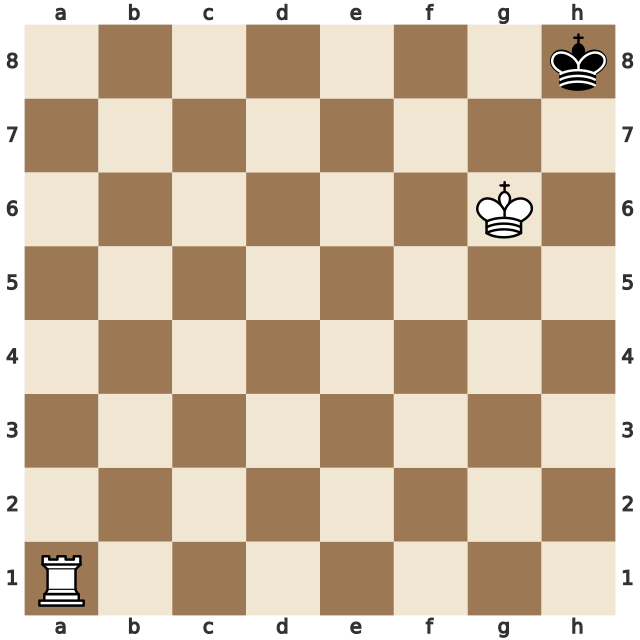
White to move. Find checkmate in one move. Explain how the white king helps the rook and why the result is not stalemate.
Your answer and reason: __________________________________________________
#6 — Improve a piece
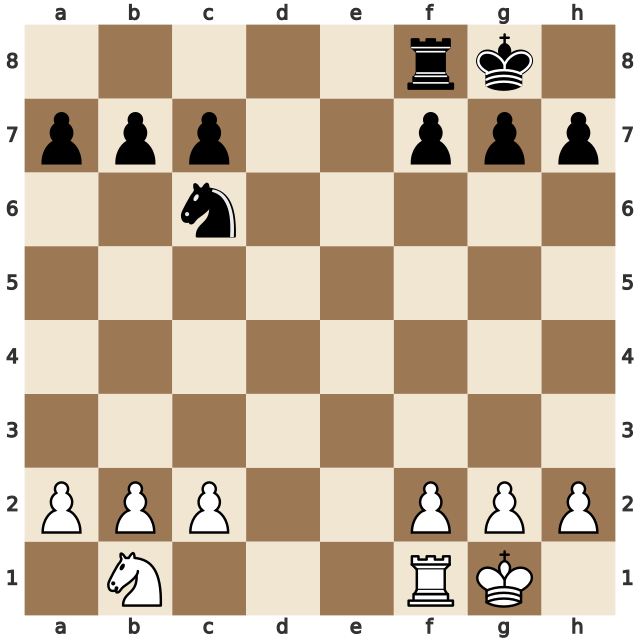
White to move. Which white piece most obviously needs a better square? Suggest an improving move and explain its purpose. Check for immediate threats before deciding. More than one sensible plan may be acceptable; you are not being asked to prove a unique best move.
Your answer and reason: __________________________________________________
Answers and what they reveal
#1 — Stalemate is different from checkmate
This is stalemate. Black are not in check, but have no legal move. The queen on g6 controls h7 and g8; the white king on f7 also controls g8 and g7. The black king cannot move to any of its neighbouring squares. With no other black piece available to move, the game is drawn.
If you called it checkmate, practise asking two separate questions: Is the king attacked now? Is there any legal move? A large material advantage does not change the stalemate rule.
#2 — Deal with the threat before following a general rule
White threaten Qxf7#. The queen would attack the king on e8 and would be protected by the bishop on c4. The natural-looking 3…Nf6? attacks the queen but does not stop 4.Qxf7#.
One adequate response is 3…g6, which blocks the queen’s diagonal to f7 and attacks it. This is not a claim that g6 is the only playable defence. The lesson is to test a developing move against the opponent’s concrete threat, rather than assume that development makes the position safe.
If you spotted the mate but chose Nf6 anyway, practise checking whether your proposed answer actually removes the danger.
#3 — Use the check to gain time
1.Nc7+ attacks the king on e8 and the rook on a8. Black must answer the check, so cannot simply move the rook away. For example, 1…Kd7 2.Nxa8 wins the rook. Other legal king moves also leave the rook available to the knight.
The full explanation matters more than recognizing the word “fork.” Name both targets, verify the check and show the capture. This exercise does not claim that the resulting king-and-knight ending is a win; it tests the tactical gain of the rook.
#4 — Do not stop when your own capture looks attractive
After 1.Bxd5 exd5 2.Rxd5, Black have 2…Qxd5. The d-file has opened, and the queen on d8 can take the rook on d5. White have given up a bishop and rook for a knight and pawn. That is not a successful pawn-winning combination.
If you stopped at Rxd5, write out the position after each capture and ask what the opponent can do next. Here the danger is a newly opened line, not a complicated calculation. The question concerns the proposed sequence, not the overall assessment of the artificial starting position.
#5 — The king and rook work together
1.Ra8# is checkmate. The rook attacks the king along the eighth rank, while the white king on g6 controls g7 and h7. Black cannot capture the distant rook, block the check or move to safety. It is not stalemate because Black are in check.
Finding this final move is only a small part of knowing the ending. To test the whole skill, practise king and rook against king from different legal starting positions. Can you bring the opposing king to the edge without losing the rook or producing stalemate?
#6 — Give the undeveloped knight a useful job
The knight on b1 is the most obvious piece to improve. A sensible move is 1.Nc3: it develops the knight and gives it influence over central squares such as d5 and e4. Black’s knight is already developed, while White have not yet brought the b1-knight into play.
This is a planning question, not a unique-move puzzle. A different legal move can receive credit if its purpose is sound and it does not overlook a concrete problem. Merely saying “knights belong in the centre” is less useful than identifying what the knight will control from its new square.
Turn the answers into a study choice
Use the descriptions below with the rules check and your explanations. You may be at different stages in different skills. These descriptions suggest what to learn next; no fixed number of correct answers assigns a level.
- Beginner learner: You are learning the board, piece movement, legal moves or the difference between check, checkmate and stalemate. Start with these rules, including special moves, in small positions. You do not need to know them all before beginning lessons, and the six positions can wait.
- Intermediate introductory learner: You can set up the board and play legal moves with the main rules understood, but still need practice noticing threats, protecting pieces, finding simple tactics or finishing short exchanges. Use the relevant positions to identify which idea needs explanation and practice.
- Advanced introductory learner: You use the rules confidently and can usually explain basic threats, simple tactics, short exchanges, elementary mating ideas and sensible piece development in unfamiliar examples. Your next step is to combine these ideas in complete games and practise basic endings from varied starting positions.
- A correct move alone is not enough to show that a skill is secure. Explain the opponent’s reply and the purpose of your move. If you need help in one area, study that area even when other tasks feel easy.
- Solving all six positions supports moving on to fresh examples; it does not by itself establish the advanced introductory stage. Check the same understanding in other positions and games. These tasks do not measure advanced competitive strength or tournament readiness.
Check the same habits in your own games
If you are still learning the rules, practise short positions with a teacher or partner before expecting yourself to review complete games. Explain which moves are legal and what changes after each move. A newly learned rule deserves practice, not a level judgment.
Once you can play a complete legal game, review a few games, including losses. Look for repeated difficulties: an unnoticed threat, an incomplete exchange, an inactive piece or an ending you could not finish. At this stage, the useful evidence is what you understand and can apply, not a rating.
Select one recurring problem, set a practical exercise for it, and test the improvement in new games. Repeating these exact six positions later can show that you remember their lessons, but new examples are needed to check whether you can apply those lessons independently.
For parents, the useful question is not simply whether a child is “good at chess.” Ask what the child understands, what they can explain without help and which skill they are ready to practise next. An accurate next step is more valuable than a flattering level label.
Continue with a focused plan
If you would like help choosing suitable lessons, bring your rules-check observations, any positions you tried and, if you already play complete games, a few recent games. A coach can use these to identify a suitable starting point without expecting you to know every rule in advance.
Build a chess study plan around the skills you need
Improve the activity of your pieces
Rules reference
The distinction between checkmate and stalemate follows the FIDE Laws of Chess, Articles 5.1.1 and 5.2.1. The positions and learning suggestions above are teaching examples, not a standardized assessment.